Claire Birkenshaw
“Chopper was my first lesson in the vast difference between myth and reality”
(Gordie Lachance, Stand by Me)
In Stigma: Notes on the Management of Spoiled Identity, Erving Goffman (1963/1990) argues that stigma is not an inherent attribute of individuals but a social relationship through which particular characteristics become discrediting. As such, virtually anyone is susceptible to stigma because what counts as discrediting, whether it concerns certain bodily characteristics, moral attributes or social affiliations, depends upon the prevailing social expectations within a particular historical context. Stigma is not a negative property, per se, as Hannem (2022, p.51) reminds us, but “the product of social definitions and value judgements.” However, Goffman (1963/1990, p.153) noted that there was only one member of American society at that time who was able to pass relatively untroubled through social life by stigma due to his constellation of favourable characteristics: namely a “young, married, white, urban, northern, heterosexual, Protestant father of college education, fully employed, of good complexion, weight and height and a recent record in sports.” Although Goffman was not writing about hegemonic masculinity, his description of the socially ‘normal’ American male closely anticipates what Connell (2005, p. 77) later conceptualised as the “culturally exalted” form of masculinity; against this ideal, all other masculinities are hierarchically ordered because it is thought to “guarantee (or is taken to guarantee) the dominant position of men and the subordination of women.” Set within this historical context, the film Stand by Me (dir. Reiner, 1986) provides a valuable sociological artefact through which to examine how boys negotiate, reproduce and occasionally resist the hegemonic expectations attached to masculinity. Drawing upon Goffman, this blog explores how masculinity is collectively negotiated through social interaction among boys in the late 1950s.
Based on Stephen King’s (1982/2021) novella, The Body, Stand by Me is set in the United States during the final days of the summer of 1959, immediately before the ‘Labor Day’ federal holiday. The film follows four adolescent boys from the small Oregon town of Castle Rock as they embark on a journey into the wilderness to search the body of a missing local boy, Ray Brower. Although the boys know that Ray is dead, the adults in the town do not. While the search for Ray’s body provides the narrative impetus, the film’s deeper concern lies not with death itself but with the ways in which masculinity is learned, rehearsed and negotiated within different social spaces, often underpinned with real or imagined violence, during early adolescence. Although much of the film unfolds during the boys’ journey through the Oregon wilderness, it opens in a very different setting: the gang’s treehouse. It is here that the boys first assemble before embarking on their search for Ray Brower, making the treehouse the film’s initial social world and an important site for examining the production of masculinity.
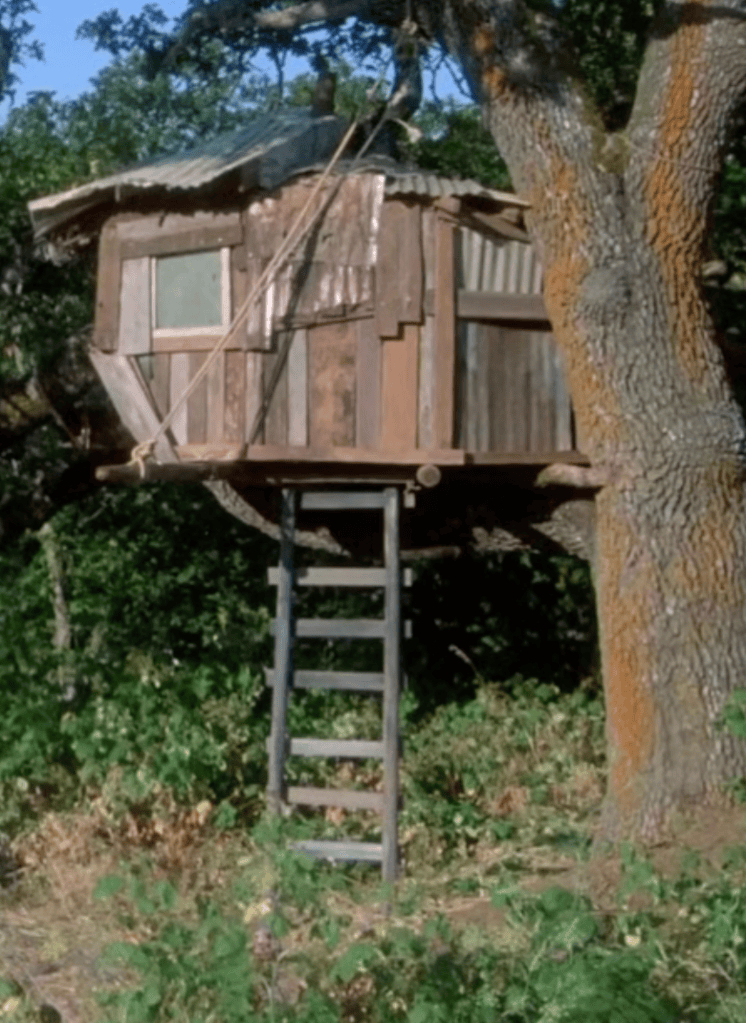
The Treehouse
The gang’s treehouse is situated on the outskirts of Castle Rock and stands in relative isolation. Elevated above the ground and overlooking Castle Rock’s industry, it consists of a single room that is accessed only by a ladder. Entry to the treehouse requires knowledge of the group’s ‘secret knock’, marking it as a space with restricted access.
The interior contains a variety of objects around which many of the boys’ interactions are organised, including crime magazines, playing cards, a portable radio, a fishing rod, and cigarettes. As they spend time together, the boys play cards, smoke and listen to music broadcast by a local radio station. Their conversation is characterised by teasing, jokes and the frequent use of profanity, much of which accompanies the competitive nature of the card game. During these exchanges, the boys challenge, mock and respond to one another while the game continues.
The boys identify themselves as a gang and appear to recognise distinctions of status within their group. The treehouse provides a place where, away from adult supervision, the boys collectively interpret family relationships, recount experiences with significant male figures, particularly fathers, and disclose experiences of violence that have shaped them. It is also the setting in which they plan future activities, including ways of gaining recognition beyond the treehouse while avoiding adult authority and the possibility of punishment.
Stigma and Biographical Burdens
As each boy crosses the treehouse’s trapdoor threshold, he brings with him a different social trajectory and biographical burden, as well as a particular relationship to stigma. Narrator Gordie Lachance enters overshadowed by his recently deceased and much-admired older brother Denny, while receiving little emotional support from his parents. Although Gordie is not himself directly stigmatised, his friendship with the other boys exposes him to what Goffman (1963/1990, p.44) terms “courtesy stigma”: in the eyes of his father, their supposedly discrediting characteristics also contaminate Gordie’s social identity. Chris Chambers, meanwhile, struggles against a familial stigma inherited from the criminal reputation of the Chambers name, despite displaying considerable emotional intelligence and moral insight. Teddy Duchamp bears the visible bodily stigma of the disfigurement inflicted by his father, compounded by the shame attached to his father’s violence and mental instability, even as Teddy continues to idealise him through a military conception of masculinity. Finally, Vern Tessio occupies the lowest position within the group’s informal hierarchy because his forgetfulness and fretful nature are interpreted as blemishes of character, making him a recurring target of teasing and ridicule. Mr Lachance’s derogatory dismissal of Vern as a “feeb”—an abbreviation of the historically stigmatising term “feeble-minded”—crystallises this discrediting judgement. It is within this elevated, secluded setting that these differently stigmatised identities are brought into interaction, making the treehouse more than simply a boyhood retreat: it becomes a social space in which masculinity is collectively produced, rehearsed and contested. In effect, the treehouse becomes a workshop in which the boys rehearse the forms of masculinity that will later be enacted beyond its walls.
Dramaturgy
To understand how this process unfolds, the treehouse can be examined through a dramaturgical lens. As Scott (2015) observes, dramaturgy is best understood as a variant of symbolic interactionism rather than a wholly separate theoretical tradition. Both perspectives focus on the micro-sociological dynamics of everyday encounters, emphasising how individuals collaboratively sustain shared definitions of situations and negotiate social identities through interaction. In addition, Edgley (2022, p. 15) describes dramaturgy as a “technique of communication” that is “endemic to the business of being human.” More fundamentally, he argues that dramaturgy concerns the ways in which people create meaning through social interaction. To think dramaturgically, therefore, is to recognise that everyday social life bears “a marked similarity to things of a theatre” (ibid., p. 18), where performances are continuously enacted, interpreted and revised by participants. Yet, as Goffman (1959/1990, p. 78), the sociologist most closely associated with dramaturgy, cautions: “All the world is not, of course, a stage, but the crucial ways in which it isn’t are not easy to specify.” For Goffman, the theatrical metaphor is therefore not a claim that social life is a literal staged performance, but a means of examining how individuals manage impressions, negotiate identities, and sustain social realities through interaction. To facilitate such analysis, Edgley (2022), drawing upon Kenneth Burke’s (1945) dramatistic pentad, proposes five interrelated dramaturgical questions centred on act, scene, agent, agency, and purpose. Respectively, these ask: What happened? Where did it happen? Who was involved? How was the act performed? and Why was it performed? Goffman’s dramaturgical framework further enriches this analysis by providing a vocabulary through which social performances can be examined, including concepts such as settings, regions (frontstage and backstage), audiences, teams, expressive equipment, and impression management. These concepts draw attention not only to the performances individuals enact, but also to the social environments, material objects, and interactional expectations that make such performances possible. Together, these questions and concepts provide a structured framework for examining the multilayered interactional dramas through which meanings and identities are produced, negotiated, and sustained.
The Treehouse as Setting and Territory
Applying this framework to Stand by Me, the treehouse can be understood as a dramaturgical setting through which the boys collectively organise and perform social identities. Goffman (1959/1990, p.33) defines a setting as a place that, in terms of its geography, “tends to stay put.” Usually, a setting is furnished, decorated, and equipped with “background items which supply the scenery and stage props for the spate of human action played out before, within, or upon it” (ibid., pp. 32–33), thereby providing the physical arrangement that makes particular performances possible. The setting is therefore not merely a passive backdrop but part of the interaction order itself, furnishing the material conditions through which performances are enacted and sustained.
The treehouse can also be understood as a territory. In Relations in Public, Goffman (1971, p. 52) describes territories as claimed bounded “preserves” containing a “field of things” that has been “staked out geographically” and which therefore requires recognition, maintenance, and defence. The treehouse functions in precisely this way: it is a spatial claim made by the boys, a place where membership is affirmed and boundaries are drawn between insiders and outsiders. As a setting, it provides the physical stage for interaction; as a territory, it provides a sense of possession and belonging. Together, these dimensions shape the conditions under which the boys construct and negotiate their identities.
Front Regions and Back Regions
Yet the treehouse cannot be understood simply as a fixed stage. It is also an oscillating region in Goffman’s dramaturgical sense, shifting between frontstage and backstage depending on the audience and the interaction taking place. Away from the adult gaze and the wider social world of Castle Rock, it operates as a backstage region, which Goffman (1959/1990, p. 114) defines as “a place, relative to a given performance, where the impression fostered by the performance is knowingly contradicted as a matter of course.” In this sense, the treehouse becomes a place where the boys can temporarily withdraw from Castle Rock’s expectations of boyhood—its “certain standards” and “moral requirements” (ibid., p.110)—imposed on them by parents, teachers, and other authority figures.
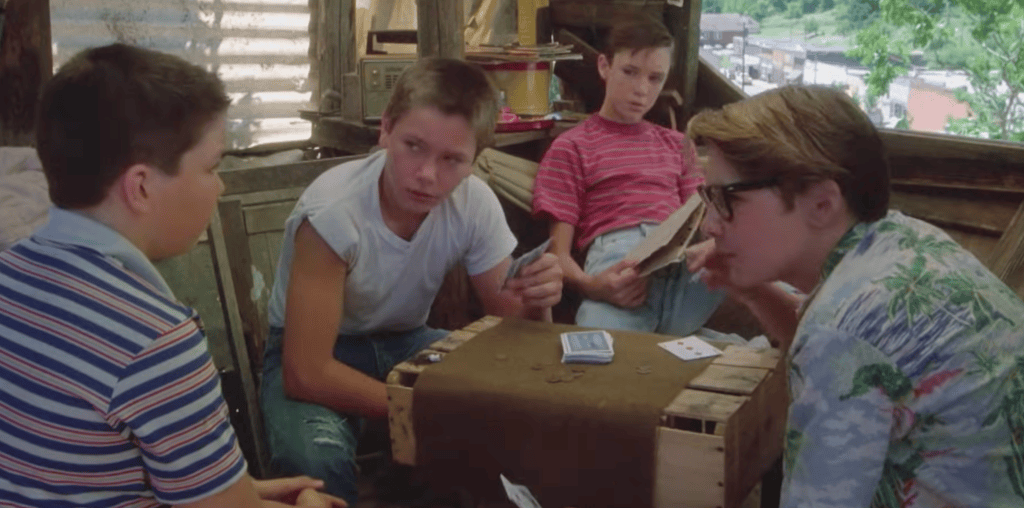
Crucially, the treehouse does not eliminate entirely the demands of culturally exalted masculinity but temporarily loosens its authority, allowing the boys to experiment with alternative ways of establishing masculine worth. This is exemplified by their use of what Goffman (ibid., p. 129) terms “backstage language”, including “profanity…smoking…sub-standard speech…playful aggressivity…‘kidding’…cooperative decision making.” The treehouse therefore functions as a space in which the boys can relax the discipline of impression management, rehearse alternative performances—as Teddy attempts to do with his nonsense phrases—and collectively sustain selves that are unavailable elsewhere. Moreover, it offers a temporary “protective capsule” (Goffman, 1963/1990, p.46) from the taken-for-granted violence and stigma that circulate through Castle Rock and provides a setting in which their moral careers (Goffman, 1963/1990, p.45) can be renegotiated and reimagined through interaction with one another, exemplified by the boys’ words of encouragement and tactile support.
Relative to the boys themselves, the treehouse also functions as a frontstage region, which Goffman (1959/1990, p. 110) defines as “the place where the performance is given,” requiring performers to maintain the impression appropriate to the situation in front of an audience that “maintains and embodies certain standards”. Although removed from adult scrutiny, the boys remain an audience for one another, meaning that interaction within the treehouse continues to involve impression management based on appropriate masculine standards.
Frontstage, Backstage and Masculinity
For Gordie, the treehouse fluctuates between backstage and frontstage regions depending on the nature of the treehouse action. When he is reading his crime magazines or thinking about plotlines for his creative writing projects it momentarily becomes a backstage region. Similarly, when Gordie seeks refuge from the hegemonic masculine standard established by Denny’s achievements—his athletic ability, popularity, and conventional success, symbolically displayed throughout his bedroom—or escapes his parents’ emotional neglect, feelings of invisibility, and survivor guilt, the treehouse functions as a backstage region. However, when the action shifts to his storytelling to the rest of the gang the treehouse resets to a frontstage region because his stories are not private reflections but public performances before an appreciative audience. Through these performances, Gordie acquires a valued face and a form of recognition denied to him within his family. The treehouse provides an alternative interactional order in which Gordie is recognised not through comparison with Denny but through his own contributions to the team. His storytelling, humour, and imagination become sources of status among his peers, allowing a different version of masculinity to emerge. In this sense, the treehouse functions as a space of re-visibility: a setting in which Gordie’s face, in Goffman’s (1967/2017) sense of the positive social value claimed through interaction, is affirmed rather than diminished.
The treehouse is therefore neither simply a backstage refuge nor merely a frontstage for performance. Rather, it is an interactional region in which identities are continuously negotiated through changing audiences, performances and definitions of the situation. Here, the boys collectively evaluate one another according to standards that differ, at least temporarily, from those prevailing elsewhere in Castle Rock. In doing so, the treehouse provides the interactional conditions through which alternative masculine selves can be rehearsed, recognised and sustained before the boys return to the wider social world.
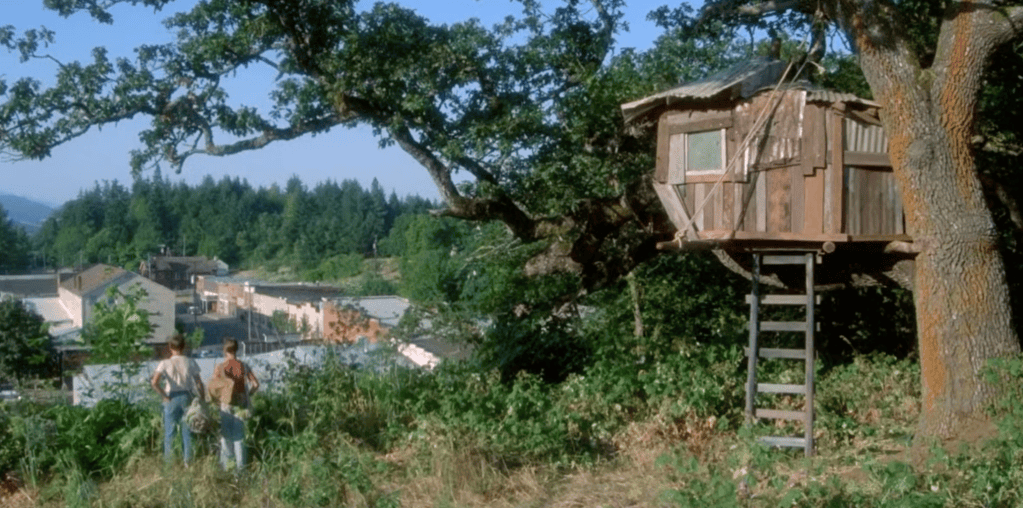
As the film concludes, Gordie and Chris stand outside their treehouse, bathed in the golden light of the rising sun, looking out across Castle Rock. The treehouse now appears less as a destination than as a transitional space between childhood and adulthood: a place in which masculine identities have been rehearsed, questioned and reshaped before re-entering the wider social world. For Gordie and Chris, leaving Castle Rock represents the possibility of escaping the identities that have been assigned to them and beginning new moral careers. The film also reminds us that such transformations remain fragile. Although individuals may reconstruct their identities, the wider culture of masculine violence that permeates Castle Rock and beyond proves far more resistant to change, as Chris’ violent death testifies.
References
Burke, K. (1945) A Grammar of Motives. Berkeley, CA: University of California Press.
Connell, R.W. (2005) Masculinities. 2nd ed. Cambridge: Polity Press.
Edgley, C. (2022) ‘Dramaturgy.’ In: Jacobsen, M.H. and Smith, G. eds. The Routledge International Handbook of Goffman Studies. Abingdon: Routledge. pp.15-25.
Goffman, E. (1959/1990) The Presentation of Self in Everyday Life. London: Penguin.
Goffman, E. (1963/1990) Stigma: Notes on the Management of Spoiled Identity. London: Penguin.
Goffman, E. (1967/2017) Interaction Ritual: Essays in Face-To-Face Behaviour. Abingdon: Routledge.
Goffman, E. (1971) Relations in Public: Microstudies of the Public Order. Harmondsworth: Penguin.
Hannem, S. (2022) ‘Stigma.’ In: Jacobsen, M.H. and Smith, G. eds. The Routledge International Handbook of Goffman Studies. Abingdon: Routledge. pp.51-62.
King, S. (1982/2021) The Body. London: Hodder.
Reiner, R. (dir.) (1986) Stand by Me. United States: Columbia Pictures.
Scott, S. (2015) Negotiating Identity: Symbolic Interactionist Approaches to Social Identity. Cambridge: Polity Press.
Suggested citation: Birkenshaw, C. (2026) ‘Stand by Goffman: Masculinity, Stigma and a Boyhood Treehouse.’ Altered States of Academia, 14 July [Online blog]. Available from:< >[Accessed?].
Acknowledgement: Generative AI (ChatGPT) was used as a writing support tool to assist with editing, improving clarity, and refining the structure of the text. The arguments, analysis, and final decisions regarding content remain the author’s own.


Leave a Reply