Claire Birkenshaw
“I don’t want to survive. I want to live!” (Captain McCrea, WALL-E)
The Ship of Consumption
In History of Madness, Michel Foucault (1972/2009) examines how Western reason constituted itself through an evolving relationship with madness: first encountering it as an unsettling bearer of truth, then excluding it as unreason and, finally, transforming it into an object of medical knowledge and institutional power. He begins this history within the Renaissance imaginary, where literary and visual forms grappled with the moral and social concerns of the period. Among these forms was the ship: a symbolic vessel carrying carefully delineated social types on imaginary voyages through which something of their collective destiny or truth might be revealed. Foucault identifies ships of princes, virtuous ladies and health as belonging to this wider “oneiric flotilla” (ibid., p. 8), although it is the “literary invention” (ibid.) of the wandering Ship of Fools (Narrenschiff) upon the rivers of the Rhineland and canals of Flanders that anchors his account of the Renaissance relationship between madness and reason.
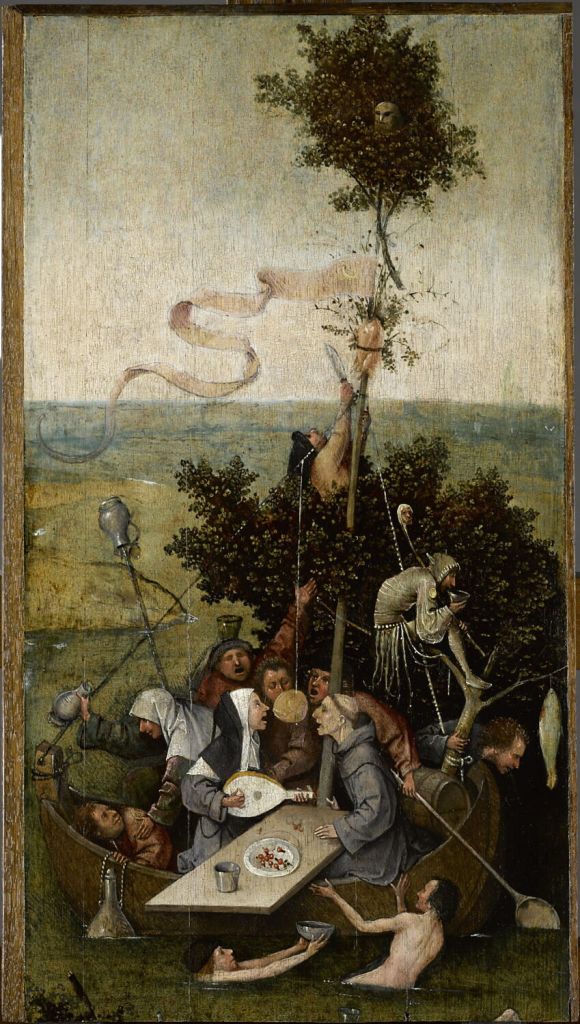
The Netherlandish painter Hieronymus Bosch gives this association between the ship, folly and social truth its most famous visual form in Ship of Fools (c.1475–1500). Within the small vessel, Bosch depicts passengers absorbed in eating, drinking, singing and competing for food, apparently indifferent to both their destination and the navigation of the boat. Religious figures participate in the revelry alongside their fellow passengers, unsettling any clear distinction between those capable of offering moral guidance and those supposedly requiring it. Most strikingly, the identifiable fool appears comparatively detached from the surrounding disorder, creating the paradoxical impression that the passengers who consider themselves rational may be the most foolish people aboard. Bosch’s vessel can therefore be understood as a miniature society adrift: its passengers are brought together not merely by their physical enclosure within the boat, but by a shared absorption in immediate appetite that leaves no one attending to their collective direction.
More than five centuries later, Pixar’s “starliner” spaceship—the Axiom—in the film WALL-E (dir. Stanton, 2008, 00:05:05) appears to join this symbolic flotilla. In keeping with the tradition identified by Foucault, the Axiom might be understood as a distinctly contemporary Ship of Consumption: a vessel carrying the characteristic social type produced by consumer capitalism—the passenger-shopper—towards the ecological and human destination implicit within that “BUY SHOP LIVE” (ibid., 00:40:02) way of life. Yet the Axiom is more than a symbolic vessel. Viewed through Erving Goffman’s work in Asylums (1961/1991), it can also be understood as a total institution whose encompassing organisation of everyday life helps to explain the passenger-shoppers’ apparent loss of autonomy, individuality and collective direction.
Set seven hundred years into the future, WALL-E introduces a sullied Earth viewed from space. As the camera descends towards the ground, the viewer is drawn into a pulverous, lifeless world almost entirely devoid of natural colour. What appear at first to be enormous termite mounds are, in fact, towers of human detritus piled to such heights they overshadow the surrounding skyscrapers. Although litter lies everywhere, a lone, weather-worn and rusted robot attempts to bring order to the disorder by compressing the rubbish it collects into neat blocks for stacking. This solitary robot is undertaking the impossible task of tidying away the accumulated waste generated by millions of human lives organised around ceaseless consumption.
After another day spent dutifully processing rubbish, the robot—otherwise known by the acronym WALL-E (Waste Allocation Load Lifter: Earth-Class)—trundles homewards through the remnants of the cityscape towards the protective refuge he has made into a home for himself, his cockroach companion, and his collection of intriguing refuse. Along the way, the viewer encounters various visual clues offering a historical explanation for Earth’s condition. Almost every aspect of human life appears to have been taken over by an all-encompassing consumer megacorporation known as Buy N Large. In this respect, Buy N Large can be understood as an extreme commercial manifestation of what Coser terms a greedy institution: one that seeks an exclusive and undivided commitment from individuals while weakening their competing roles and attachments (Coser, 1974; Egger de Campo, 2013). Having apparently eliminated all commercial and institutional rivals, Buy N Large inserted itself between people and almost every necessity, pleasure and experience of everyday life. Its control was therefore totalising without having become institutionally total: people were gently coerced into a lifestyle of thoughtless yet comforting consumption through continuous saturation by visual and auditory advertising. The Buy N Large brand had, in effect, colonised human consciousness by branding it with compulsive consumerism, apparently without consequences—or so its consumers were encouraged to believe.
Given such heedless consumption, it was inevitable that Earth’s life-supporting systems would be placed under intolerable strain, pushing them to the point of collapse. When they finally did, humanity was not evacuated in fear but seamlessly upgraded to a fleet of Buy N Large luxury starliners where consumption continued unabated as an exclusive Buy N Large experience amid the advertised novelty of “plenty of space, out in space” (WALL-E, 2008, 00:05:01). Once aboard, passengers were promised a stylish five-year cruise aboard a “fully automated” (ibid., 00:05:21) Buy N Large starliner offering its signature “non-stop entertainment and fine dining” (ibid., 00:05:26). Meanwhile, Buy N Large’s fleet of WALL-Es set about the impossible task concealed within the corporation’s reassuring promise to “clean up the mess” (ibid., 00:05:07) of an entire planet.
Seven centuries later, humanity continues to live in space, having never returned home as originally intended under “Operation Recolonise” (ibid., 01:08:26). After Buy N Large’s attempt to restore Earth with “Operation Clean-Up” (ibid., 01:08:13) failed, its chief executive and global president, Shelby Forthright, secretly transmitted Directive A113 in 2110 to the fleet’s autopilots, overriding human command with one unambiguous instruction: “Do not return to Earth” (ibid., 01:08:52). None of the Axiom’s original passenger-shoppers remains; successive generations of their descendants—hereafter referred to as Axiomites—have instead been born and raised aboard the ship. Over time, the social organisation of life within the Axiom has evolved until it no longer resembles a stylish five-year cruise floating carefree across the “final fun-tier” (ibid., 00:05:40). Certain features of the original cruise remain—including Buy N Large uniforms, “all-access hoverchairs” (ibid., 00:05:28), relentless advertising and continuous shopping—but other dimensions of human life have gradually eroded. Physical fitness and mobility have atrophied, recognisable family life has disappeared from view, and human agency has largely been surrendered to automated systems. The Axiomites are therefore no longer passengers in any meaningful sense but inhabitants of an enclosed social world organised entirely by Buy N Large. What began as a temporary consumer paradise has inadvertently mutated into something more encompassing: a total institution. Yet it bears little resemblance to the places through which the total institution is ordinarily imagined.
The total institution occupies a familiar place within the cultural imaginary. It is commonly represented as an austere and visibly coercive place: the prison enclosed by walls, the asylum secured by locked doors or the psychiatric ward governed through clinical surveillance and discipline. One of its most recognisable cultural forms is Nurse Ratched’s ward in Ken Kesey’s One Flew Over the Cuckoo’s Nest (1962/2005), set in an unnamed Oregon psychiatric hospital and subsequently brought to the screen at Oregon State Hospital in Miloš Forman’s 1975 adaptation. Within the ward, institutional order is maintained through medication, regulated routines, therapeutic scrutiny and the classification of conduct as evidence of mental disorder. The individual confronts an institution that is recognisably restrictive, even when its coercive practices are presented as treatment. The Axiom appears to belong to an altogether different cultural imaginary. Brightly illuminated, endlessly entertaining and “fun” (WALL-E, 2008, 00:39:51), the Axiom appears devoted to consumer gratification, presenting itself as a luxury cruise ship undergirded by a “BUY SHOP LIVE” (ibid., 00:40:00) rationality rather than a psychiatric hospital. Beneath these contrasting surfaces, however, lies a remarkably similar organisational logic.
The Axiom as Total Institution
Goffman (1961/1991) argues that all institutions, to varying degrees, organise aspects of their members’ lives, shaping how they spend their time, direct their interests and experience the social world. Some institutions, however, are distinguished by the extent to which they encompass almost every dimension of everyday existence. They are separated from wider society by social and physical barriers that restrict external interaction and make departure difficult, including locked doors, high walls, fences and natural obstacles. Goffman calls these highly encompassing organisations “total institutions” (ibid., p. 16).
Goffman suggests that total institutions can be broadly grouped into five categories. The first comprises institutions providing care for people regarded as incapable of independent living yet posing no threat to others, such as homes for older people. The second combines care with the protection of wider society, as in psychiatric hospitals. The third consists of institutions established primarily to protect society from those perceived to be dangerous, including prisons. Of particular relevance here, Goffman’s fourth category encompasses organisations established to accomplish particular tasks efficiently, including boarding schools, work camps—and ships. Finally, the fifth comprises institutions facilitating withdrawal from wider society for religious devotion and spiritual formation, such as monasteries.
Although these institutions serve markedly different social purposes, they share a common organisational logic. According to Goffman (1961/1991), modern social life ordinarily separates three major spheres—work, leisure and domestic activity—across different places, social groups and authorities. Within a total institution, the boundaries separating these spheres are erased. Everyday life unfolds in the same place under a single authority; activities are undertaken collectively alongside others who are treated alike; routines are tightly scheduled and regulated; and individual actions are coordinated into a single rational plan designed to fulfil the institution’s official aims. This collective organisation enables a relatively small supervisory apparatus to oversee a “large batch” (ibid., p. 17) of similar-fated people through continual surveillance rather than periodic inspection. Conformity is thereby rendered unusually visible: when everyone is expected to move through the same prescribed routine, even the smallest departure from institutional expectations becomes conspicuous.
Floating in outer space rather than standing behind walls or fences on Earth, the Axiom nevertheless bears striking similarities to this organisational model. First, all aspects of life aboard the starliner are “conducted in the same place and under the same single authority” (ibid., p. 17): Buy N Large. Second, its Axiomites move as a batch through a “collectively regimented” (ibid.) daily life, wearing interchangeable red—and subsequently blue—Buy N Large uniforms, drinking the same liquefied food and undertaking much the same activities. Third, “all phases of the day’s activities are tightly scheduled” (ibid.) through ambient systems that collectively regulate when passengers wake, eat, consume and sleep. Even their movements are coordinated by supposedly all-access hoverchairs, which carry them economically along predetermined circuits of convenience from one consumer experience to another. Finally, these various activities are integrated into a “single rational plan designed to fulfil the official aims” (Goffman, 1961/1991, p. 17) inherited by the Axiom: maintaining human life aboard indefinitely while preventing any return to Earth. Perpetual consumption provides the organisational routine through which this aim is quietly accomplished. Stationary cameras and the electronic eyes of supervisory robot helpers ensure that this smoothly regimented plan remains under continual observation. These readily visible correspondences establish the broadly totalising organisation of the Axiom. To appreciate the full sociological force of Goffman’s analysis, however, it is necessary to follow WALL-E further into the “Jewel of the BNL fleet” (WALL-E, 2008, 00:05:15) and examine how this organisational logic reaches into the finer details of everyday life—and, ultimately, into the Axiomites’ sense of self.
As WALL-E enters the Axiom, he is greeted by an uncontaminated and meticulously ordered environment that stands in sharp contrast to the toxified disorder of Earth. Robots resembling the support staff of terrestrial hospital institutions maintain this cleanliness and order throughout the apparently passenger-free lower decks. Carried upwards through arterial service tunnels, WALL-E eventually reaches an area where electronic signage announces “Welcome to Economy” (ibid., 00:40:02). Here, the abstract organisational features identified above become embodied in the starliner’s human population: a multitude of uniformly dressed Axiomites conveyed through carefully regulated space in individual all-access hoverchairs. More revealing than this visible regimentation, however, is the extent to which Buy N Large has entered into the texture of their everyday lives. Each chair’s immersive screen directs consumer activity while mediating communication with others, and snatches of overheard conversation suggest lives organised by repetition and permeated by boredom. Throughout the ship, Buy N Large’s coddling corporate voice addresses the passengers, reassuring them that everything required for a “happy” day has already been provided—something that is, they are told, “very important” to the company (ibid., 00:41:22–00:41:25). This pleasing paternalism is delivered in soothing, maternally coded tones, creating the impression that passengers remain free to curate their own experiences; in practice, their choices have already been anticipated and gently steered. Even the promised experience of fine dining has disappeared, replaced by liquidised food served satisfyingly “in a cup” (ibid., 00:41:23) and subtly marketed as an improvement because it removes the inconvenience of cutting and chewing. Beneath the apparent comfort and convenience of this meticulously managed world, something distinctly uncomfortable has happened not merely to the Axiomites’ sense of self, but to the Axiomites as individuals. From a Goffmanian perspective, this can be understood as a gradual mortification—and, across later generations, institutional formation—of the self. Indeed, although this mortification by degrees intensified aboard the Axiom, the consumer selves upon which it operated had been shaped long before the “starliner” departed Earth.
Mortification by Degrees
As Goffman scholars Jacobsen and Kristiansen (2015) remind us, Goffman’s research for Asylums sought to examine the effects of hospitalisation on the patient’s self. He conceptualised total institutions as “forcing houses for changing persons” that conduct “a natural experiment on what can be done to the self” (Goffman, 1961/1991, p. 22). Accordingly, he paid close attention to the array of institutional arrangements that “systematically” (ibid., p. 24) targeted the patient’s sense of self in pursuit of organisational goals. The cumulative effect of these arrangements, he concluded, was the “mortification of the self”: a process through which patients were progressively stripped of the identities, rights and social roles they had possessed beyond the institution’s walls (ibid., p. 30). This process could culminate in what Goffman termed “civil death” (ibid., p. 25).
The first step in this process was the barrier separating the world inside the institution from the “home world” (ibid., p. 24) beyond its walls. Once inside, patients lost control over their “role scheduling” (ibid.) because the timing and performance of their activities were now governed by the institutional authority. The resulting “role dispossession” (ibid.) produced “a deep initial break with past roles” (ibid.). Goffman nevertheless acknowledged that, where “entrance is voluntary” (ibid., p. 25), some withdrawal from the home world might already be under way, lessening the shock of an abrupt severance between worlds without necessarily removing the pain it caused.
Arguably, the Axiom’s original passengers experienced this rupture less intensely because Buy N Large ensured that their Earthbound identities as “BUY SHOP LIVE” (WALL-E, 2008, 00:03:57; 00:40:00) consumers continued aboard the starliner. They may have crossed the spatial barrier between Earth and the Axiom, but their consumer role crossed with them. Indeed, the five-year cruise promised not the abandonment of consumer life but its luxurious continuation. Buy N Large thereby concealed role dispossession beneath the appearance of role continuity: the passenger-shoppers remained shoppers even as almost every other dimension of their former social lives gradually disappeared.
Moreover, the debasing admission procedures that Goffman collectively describes as “trimming”—including “taking a life history, photographing, weighing, fingerprinting, assigning numbers, searching, listing personal possessions for storage, undressing, bathing, disinfecting, haircutting, issuing institutional clothing, instructing as to rules, and assigning to quarters” (Goffman, 1961/1991, pp. 25–26)—were reimagined as the amenities of a luxury cruise. Quarters became cabins, compulsory haircutting became a visit to the hair salon in order to “feel beautiful” (WALL-E, 2008, 00:41:32), and institutional uniforms became colour-changing comfortwear. Procedures that might otherwise have appeared intrusive or degrading were thus repackaged as services performed for the passengers’ convenience and enjoyment.
In effect, the coercive institutional trimming ordinarily used to engender pliancy was largely unnecessary because Buy N Large had already “shaped and coded” (Goffman, 1961/1991, p. 26) its customers as obedient consumers before they boarded the Axiom. Even the surrender of personal possessions was displaced from view: the passenger-shoppers departed Earth while the accumulated material remains of their former consumer lives were left behind for WALL-Es to compress into manageable blocks. They arrived aboard the Axiom not as resistant selves requiring immediate mortification, but as consumer selves already prepared for institutional capture and gradual compression into an administratively manageable batch. Once aboard, they could therefore be continually circulated along predetermined circuits from one managed consumer experience to another. As successive generations became permanently bound to their all-access hoverchairs, this circulation—and the population itself—became easier for Buy N Large to control.
Consumer Looping
The Axiom’s institutional order is not merely spatial. It also assumes a consumerist version of what Goffman terms “looping”: an institutional process through which an individual’s response to an assault upon the self becomes the occasion for further institutional intervention (ibid., p. 41). The conditions for this looping are established in early childhood. Aboard the Axiom, even young children are socialised into Buy N Large’s consumer worldview. During one classroom scene, a Bot Teacher instructs hoverchair-bound toddlers that “A is for Axiom, your home sweet home” and “B is for Buy N Large, your very best friend” (WALL-E, 2008, 00:41:12–00:41:19). The lesson is as much about belonging as it is about literacy. Glued to their individual screens, every child quietly sucks on a pacifier while absorbing the lesson as a perfectly behaved batch. Before alternative understandings of home, community or identity could emerge, the institution had already supplied these children with the vocabulary—and habits of compliant conduct—through which they would learn to interpret the world. Earth is conspicuous by its absence. For children born aboard the Axiom, “home” no longer denotes a life-sustaining organic planet but a sterile, corporation-managed environment. Whether through the advertising-saturated consumer culture of Earth or the institutional socialisation of Axiom-born generations, Buy N Large had already “shaped and coded” (Goffman, 1961/1991, p. 26) individuals as consumers and enclosed them within an environment in which shopping remained one of the few available expressions of agency. Their continued consumption could then be treated by the Axiom’s automated systems as confirmation that they were naturally shoppers requiring further opportunities to shop. Buy N Large provided shops because the Axiomites were shoppers, while the Axiomites remained shoppers because Buy N Large provided shops. Institutionally induced behaviour was thereby looped back as evidence of individual preference, enabling Buy N Large’s consumer regime continually to validate and reproduce itself.
This circular production of consumer preference is accompanied by a more specifically Goffmanian form of looping. The Axiom’s systems progressively diminish the Axiomites’ capacity for autonomous action and then treat the resulting dependency as evidence that further assistance is required. Hoverchairs produce immobility, while immobility confirms the passengers’ need for hoverchairs; screen-mediated existence weakens direct social interaction, while their resulting isolation makes further technological mediation appear indispensable. Institutionally induced incapacity is thereby looped back as justification for deeper institutional intervention. AUTO, like Nurse Ratched in One Flew Over the Cuckoo’s Nest, stands at the centre of this closed circuit as its ultimate institutional custodian. Whenever WALL-E—or eventually the Captain—interrupts it, AUTO mobilises the Axiom’s automated systems to return the deviant passenger, robot or commander to their proper institutional course.
Disruptive Contamination
Like McMurphy’s arrival on Nurse Ratched’s ward in One Flew Over the Cuckoo’s Nest, WALL-E’s entrance into the Axiom places an institutionally troublesome outsider inside a meticulously ordered world. The difference is that WALL-E has no intention of causing trouble. He becomes deviant simply by being unable to follow the institutional script. Almost immediately, his caterpillar tracks carry Earthly dirt across the starliner’s immaculate cleaning circuits, leaving behind a trail of contamination that the fastidious cleaning bot M-O compulsively attempts to remove. When WALL-E strays beyond the designated cleaning zone, M-O eventually crosses the line marking the limit of its own operational circuit and pursues him. WALL-E’s disorder is therefore not merely material but organisational: his “foreign contaminant” (WALL-E, 2008, 00:37:09) dirt draws another robot out of its prescribed course. Deviation, like contamination, begins to spread.
Wherever WALL-E passes, something—or someone—is knocked out of its institutional circuit. He accidentally causes John to tumble from his supposedly all-access hoverchair, prompting an unmediated exchange of names and the beginnings of friendship. He disrupts Mary’s immersive screen, directing her attention away from Buy N Large’s electronic world and towards the Axiom’s physical environment, where she discovers a previously unseen swimming pool. In the repair ward, WALL-E releases a collection of malfunctioning robots whose unpredictable conduct introduces further disorder into the starliner’s meticulously regulated spaces. Ultimately, WALL-E’s discovery of the plant—and his determination to protect it—awakens Captain McCrea from his institutionally induced lethargy and encourages him to reclaim command of his own ship. The disruption that begins with M-O crossing a circuit line culminates in a physical struggle for control, as the Captain stands on his own feet and relieves AUTO of his “duty” (ibid., 01:22:50) by simply switching him off.
The parallel with McMurphy acquires a darker resonance towards the film’s conclusion. While attempting to protect the plant, WALL-E is crushed beneath the Holo-Detector as AUTO attempts to close it. Although EVE subsequently repairs his body on Earth, the WALL-E who mechanically resumes compacting rubbish appears emptied of memory, attachment and recognition. Like McMurphy following his lobotomy, WALL-E returns in a mechanically operational but biographically emptied condition. Unlike McMurphy, however, he is not lost: through recognition, attachment and touch, EVE reanimates the self that institutional violence has seemingly mortified.
WALL-E survives because his self was never entirely contained within his mechanical body. It also existed relationally: in the objects he had cared for, the gestures he had learned and, most importantly, EVE’s recognition of him. Where McMurphy’s altered body becomes evidence that Nurse Ratched’s institution has extinguished the person he had been, EVE refuses to accept WALL-E’s mechanical functioning as equivalent to his survival. Her efforts rest upon the same distinction Captain McCrea has already discovered: remaining operational is not the same as being alive.
Bringing Goffman Back to Earth
The Axiom cannot be made to fit every detail of Goffman’s model—and nor must it. As Sundberg (2022) reminds us, Goffman recognised that the characteristics he identified were neither exclusive to total institutions nor present in precisely the same form within every example. What distinguished these institutions was not their perfect conformity to a conceptual checklist, but the intensity with which several totalising features appeared together. His model is therefore best approached not as a rigid classificatory container but as a conceptual resource for sociologists to think with and develop, as Scott’s (2011) Total Institutions and Reinvented Identities creatively demonstrates. The important question is not whether the Axiom passes a definitive test of institutional totality, but what becomes visible when life aboard the starliner is viewed through Goffman’s conceptual lens.
Certain differences are immediately apparent. First, the original passenger-shoppers entered voluntarily, while their descendants were never admitted in any conventional sense but were born inside the institution. Second, the original passenger-shoppers experienced mortification gradually rather than through an abrupt admission procedure, while their Axiom-born descendants possessed no remembered “home world” (Goffman, 1961/1991, p. 24) against which institutional life could be judged. Third, the conventional division between human inmates and supervisory staff has been displaced onto a relationship between Axiomites and the automated systems that organise their lives. These departures do not invalidate the comparison. Instead, they reveal how the organisational logic of the total institution might assume a different historical form: one maintained less through visible coercion than through comfort, convenience and the progressive disappearance of alternatives.
The Ship of the Fooled
WALL-E’s disruption ultimately returns us to the Ship of Fools with which this discussion began. Like the comparatively detached fool aboard Bosch’s vessel, WALL-E occupies an ambiguous position within the social world he encounters. To the Axiom’s automated systems, his behaviour appears irrational: he crosses designated boundaries, contaminates sterile environments, collects objects without regard for their assigned function and repeatedly jeopardises institutional order to protect another being. Such seemingly transgressive circuit-breaking instead exposes the greater irrationality of the rationally administered world around him. While AUTO follows Directive A113 with mechanical consistency, humanity cycles futilely through space aboard a vessel devoted to sustaining life while denying its passengers the opportunity genuinely to live.
Bosch’s passengers remain absorbed in immediate appetite while no one attends to the navigation of their vessel. The Axiomites likewise consume, converse and circulate without noticing either their destination or who is steering the ship. In both vessels, the apparently rational passengers are revealed as the most foolish people aboard, while the figure who stands partially outside their shared absorption makes their collective folly visible. WALL-E therefore functions not simply as an institutional deviant but as the Axiom’s unrecognised fool: the outsider whose supposedly irrational conduct restores reason to a society that has lost sight of it.
By carrying dirt into cleanliness, disorder into routine and attachment into an institution organised around managed consumption, WALL-E interrupts the circuits through which Buy N Large has mistaken survival for living. Captain McCrea’s declaration—“I don’t want to survive. I want to live!” (WALL-E, 2008, 01:09:44)—names the truth that the Axiom’s fool has made visible. Only when its passengers break free from Buy N Large’s imposed consumer loop can their ship escape the gravitational pull of institutional totality, recover its destination—and allow humanity to renew its relationship with nature by reclaiming its home on Earth.
References
Bosch, H. (c.1475–1500) Ship of Fools [oil on wood]. Held at Musée du Louvre, Paris.
Coser, L.A. (1974) Greedy Institutions: Patterns of Undivided Commitment. New York: Free Press.
Egger de Campo, M. (2013) ‘Contemporary greedy institutions: An essay on Lewis Coser’s concept in the era of the “hive mind”’, Czech Sociological Review, 49(6), pp. 969–988.
Foucault, M. (1972/2009) History of Madness. Translated from the French by J. Murphy and J. Khalfa. Abingdon: Routledge.
Goffman, E. (1961/1991) Asylums: Essays on the Social Situations of Mental Patients and Other Inmates. London: Penguin.
Jacobsen, M.H. and Kristiansen, S. (2015) The Social Thought of Erving Goffman. Thousand Oaks, CA: SAGE.
Kesey, K. (1962/2005) One Flew Over the Cuckoo’s Nest. London: Penguin Classics.
One Flew Over the Cuckoo’s Nest (1975) Directed by Miloš Forman [Film]. United States: United Artists.
Scott, S. (2011) Total Institutions and Reinvented Identities. Houndmills: Palgrave Macmillan.
Sundberg, M. (2022) ‘Total institutions’ In: Jacobsen, M.H. and Smith, G. eds. The Routledge International Handbook of Goffman Studies. Abingdon: Routledge. pp. 63-73.
WALL-E (2008) Directed by Andrew Stanton. Available from: Disney+ [Accessed 20 July 2026].
Suggested citation: Birkenshaw, C. (2026) ‘One WALL-E Flew Over the Axiom: Erving Goffman Goes into Space.’ Altered States of Academia, 25 July [Online blog]. Available from:< >[Accessed?].
Acknowledgement: Generative AI (ChatGPT) was used as a writing support tool to assist with editing, improving clarity, and refining the structure of the text. The arguments, analysis, and final decisions regarding content remain the author’s own.
 Altered States of Academia
Leave a comment