Claire Birkenshaw
“It is my professional opinion that now is the time to PANIC!” (Human Child Expert, Monsters, Inc.)
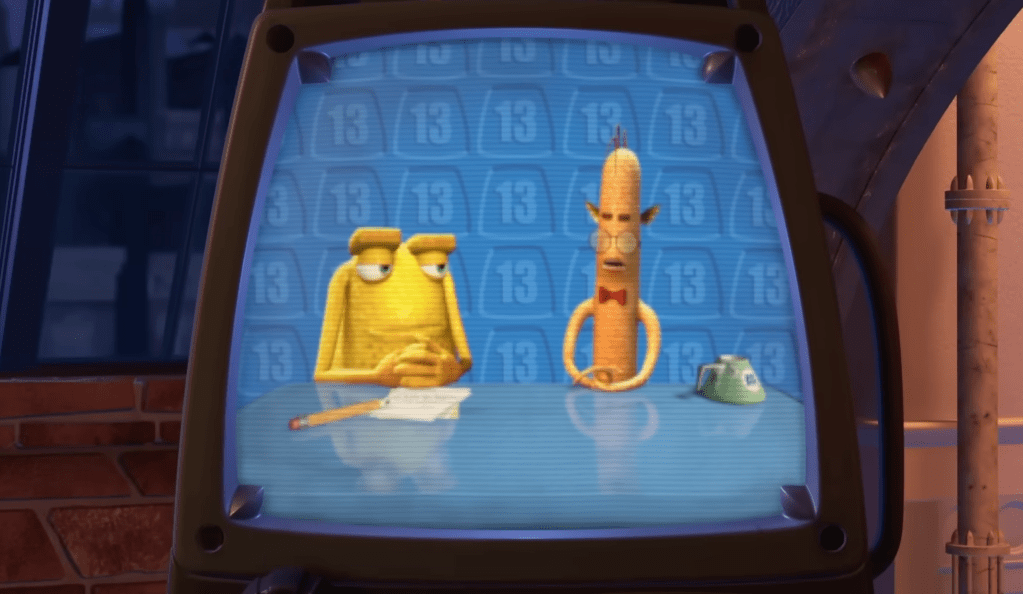
It is a television news moment that is all too familiar: after broadcasting a series of eyewitness accounts, the News 13 anchor turns to a bespectacled, bow-tied expert to provide a calm and authoritative interpretation of events for viewers. On this occasion, however, something goes awry. Rather than restoring professional composure, the expert becomes swept up in the very hysteria the broadcast has helped to produce, concluding that “now is the time to PANIC!” (Monsters, Inc., 2001, 00:28:57). It is a scene in Monsters, Inc. (dir. Pete Docter, 2001) that is both wonderfully comedic and satirically sharp, characteristic of Pixar’s multilayered storytelling, which rewards children and adults in different ways. But beneath the humour lies a serious observation about the media’s capacity to frame events in ways that shape public belief and conduct. As Booker (2010) reminds us, the premise of Monsters, Inc. is the coexistence of interconnected monster and human worlds that are remarkably similar to one another. The fears circulating through Monstropolis—the monsters’ urban enclave—therefore function not simply as fictional anxieties but as humorous reflections of recognisable human fears, inviting audiences—particularly adults—to laugh at media practices that are, beyond the cinema, altogether more familiar.
Film offers more than an engaging illustration of sociological ideas. As a socially and historically crafted artefact, it can reveal prevailing assumptions, anxieties and ways of seeing, while inviting viewers to consider how particular meanings are constructed rather than merely represented (Barber, 2015). Its familiarity also gives abstract theory something tangible to hold onto: film can stimulate the sociological imagination, strengthen critical observation and connect academic concepts to recognisable experiences (Hunter and Frawley, 2022). This is especially valuable for child professionals working across education, health, social services, law and the judiciary, whose practice requires them to interpret the complex and sometimes contradictory lived experiences of children and families (Aitken, 2018). Used critically, a family film such as Monsters, Inc. does not provide a transparent window onto childhood. Instead, it offers a conduit through which established assumptions can be questioned, theory brought into conversation with practice, and familiar representations of children made newly visible. As such, Monsters, Inc. will be used to explore how the media of Monstropolis construct the human child as a social threat, and how the accidental arrival of Boo—the film’s two-year-old human protagonist—generates a response that can be understood through Stanley Cohen’s (2002/2011) concept of moral panic.
Monsters Primed to Panic
Like their human counterparts, monster society is saturated with a diverse media landscape. Monsters watch television, read newspapers and consume specialist publications, ranging from the comparatively sober broadsheet The Monstropolis Horn (Monsters, Inc., 2001, 00:07:56) and the sensationalist tabloid The Daily Glob (ibid., 00:11:53) to trade magazines such as Business Shriek (ibid., 01:23:13). Their presence is more than decorative world-building. Collectively, these media outlets furnish Monstropolis with a recognisably modern information environment through which events are socially interpreted, fears circulated and public opinion organised. The Monstropolis Horn, for example, reports that “Prices Double at Pump” amid fears of “Rolling Blackouts” and a looming “Scream Shortage”, attributed to “Modern Kids [being] Harder to Scare” (ibid., 00:07:56; see Figure 1). Alongside these warnings appears an apparently reassuring statement from Mr Waternoose, Chief Executive Officer of the city’s energy supplier, Monsters, Incorporated (M.I.): “No need for concern, says the M.I. boss” (ibid.). The juxtaposition is revealing: Waternoose’s reassurance does not dispel the crisis narrative but becomes incorporated within it. The circulation of this narrative appears to translate collective anxiety into everyday conduct, encouraging monsters to modify their behaviour in anticipation of worsening scarcity. Its practical influence is suggested when M.I.’s top Scarer, James ‘Sulley’ Sullivan, reminds his work partner, Mike Wazowski, that “there’s a scream shortage” (ibid., 00:07:46) after Wazowski proposes driving to work. Wazowski reluctantly leaves his car behind and walks to the M.I. factory with Sullivan.
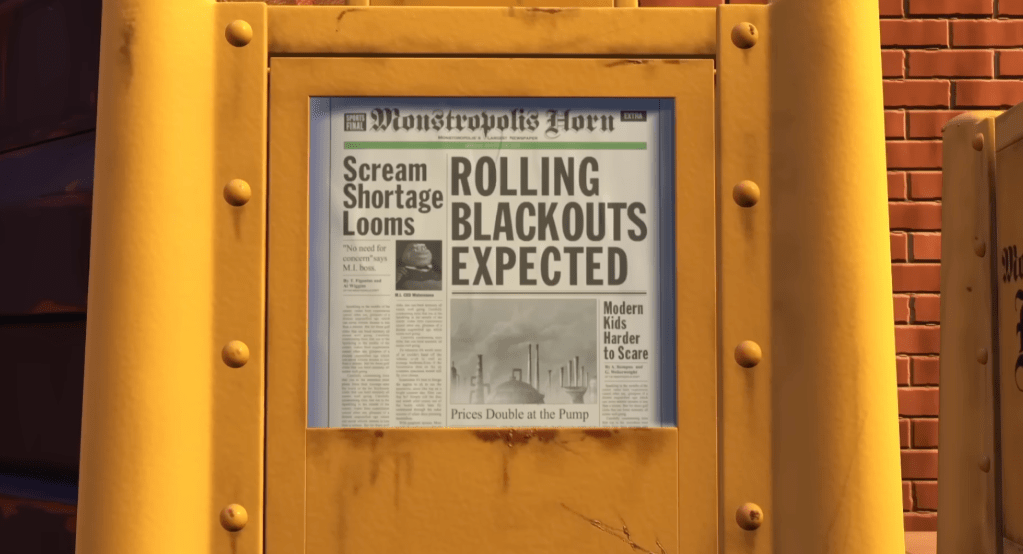
In reporting the energy crisis, the newspaper reproduces a causal narrative already circulated by Monsters, Incorporated and propagated by Waternoose to its trainee Scarers. The company advertisement reminds monsters that M.I. powers their carefree existence, before warning that the human child’s “window of innocence is shrinking” (ibid., 00:06:32) because children are becoming harder to scare. Monstropolis is thereby encouraged to understand its entire way of life as dependent upon an increasingly unreliable supply of scream energy. Waternoose simultaneously intensifies this insecurity by warning M.I.’s trainee Scarers that there is “nothing more toxic or deadly than a human child”: “A single touch could kill you. Leave a door open, and a child could walk right into this factory, right into the monster world” (ibid., 00:04:00–00:04:14). Children consequently occupy a contradictory position within monster society. Their screams are presented as essential to its survival, while their physical presence supposedly threatens its destruction. In effect, monster scare-power no longer produces the energy it once did. Its continuing decline raises the prospect of an energy and employment crisis and, ultimately, of Monstropolis losing its power entirely, threatening the monsters’ material security and placing their established way of life at risk. It also weakens the monsters’ ontological security (Giddens, 1991): they can no longer assume continuity and order in a world where children are becoming harder to scare and the energy system organised around frightening them is beginning to fail. Even the advertisement’s reassuring claim that M.I. is “working for a better tomorrow…today”—because “we scare because we care” (Monsters, Inc., 2001, 00:06:48–00:06:59)—exemplifies Giddens’s (1991, p. 244) concept of risk culture, in which awareness of risk becomes a means of “colonising the future”. M.I. casts its existing practices as protection against future insecurity, constructing a reassuring corporate narrative intended to preserve trust in the very institutions circulating these anxieties. Boo therefore enters a society whose confidence in the stability of its established order is already weakening. By crossing from the human world into Monstropolis, she transforms a carefully managed risk into an embodied presence, puncturing the protective cocoon(ibid.) that ordinarily filters out external dangers. Monstropolis is already primed to panic; Boo merely passes through the door.
Boo: The Diminutive Folk Devil
What unfolds in Monstropolis can be understood through Stanley Cohen’s (2002/2011) influential account of moral panic, set out in Folk Devils and Moral Panics: The Creation of the Mods and Rockers. For Cohen (ibid., p. 1), a moral panic occurs when a “condition, episode, person or group of persons” becomes defined as “a threat to societal values and interests”. Such panics, he later explains, depend upon the generation of “diffuse normative concerns” around which a recognisable folk devil can be constructed (ibid., p. 61). Boo fulfils this role with almost comic precision. As the visible embodiment of the already-feared human child, she becomes Monstropolis’s diminutive folk devil: a condensation nucleus around which anxieties about energy scarcity, declining scare-power, social collapse and monster mortality coalesce. Already placed into circulation by corporate propaganda and the media, these anxieties socially charge Boo with meanings and fears that greatly exceed any observable danger she presents. In a striking reversal of the coercive, mechanical Scream Extractor devised by Randall Boggs—Sullivan and Wazowski’s chameleon-like competitive co-worker and, as later becomes apparent, Waternoose’s plant in the energy plant—Boo thereby becomes an unwitting extractor of monster fear.
For generations, monsters have imagined human children to be inherently toxic and deadly, necessitating extreme caution during the extraction of their screams. This established positioning of the child as dangerous is reproduced throughout M.I.’s operations: in Waternoose’s warnings to trainee Scarers, the vast archive of psychological profiles used to extract the maximum scream from each child, and the CDA’s theatrical performance of contaminant containment following an on-site “2319” alarm (Monsters, Inc., 2001, 00:17:43). These practices do not, in themselves, constitute a moral panic because monster society is routinely organised around the assumption that children are hazardous. What is new, however, is the growing belief that children are losing their fear of monsters as the human world progressively evolves beyond monster control. It is not human children as biological beings that are changing, but the social conditions under which their childhoods are lived.
Menacing Warning Signs
This transformation becomes measurable through declining scream production—a problem of which M.I. is acutely aware and about which monsters are repeatedly warned, both in the workplace and through the media. The signs accumulate: incredulous Scarer testimony—“She wasn’t scared of you? She was only six!” (ibid., 00:16:02); an increasing number of children’s closet doors taken out of circulation and shredded; and falling energy output. Together, they appear to confirm the emergence of a new social figure: the fearless child, deceptively familiar in appearance but increasingly resistant to the power upon which Monstropolis depends. If a lapse in border security leaves “a door wide open” (ibid., 00:04:10), such a child might enter “right into the monster world” (ibid., 00:04:12), bringing both physical contamination and social disorder—or what News 13 will later sensationalise as a “KID-TASTROPHE!” (ibid., 00:28:36). M.I. responds by seeking new methods of scream extraction alongside simulator-based Scarer training, while the CDA’s militarised containment procedures attempt to reinforce the boundary between the two worlds. Yet these preparations remain responses to an anticipated danger. Boo’s visible presence in Monstropolis converts that culturally established fear into an identifiable public event around which a moral panic can crystallise.
We Panic Because We Can
However, a folk devil alone does not make a moral panic. For a moral panic to cohere, Cohen (2002/2011, p. xxxviii) argues, society must generally be infused with “stable, patterned structures” formed by “politics, mass media, crime control, professions and organised religion”, without which “no moral panics could be generated or sustained”. Moral panic, then, does not emerge from social chaos but is produced through an established social order capable of identifying, interpreting and controlling a perceived threat. Despite the energy crisis unsettling its inhabitants, Monstropolis remains a discernibly stable and structured society. It possesses a diverse mass media, accredited experts, corporate authority, municipal government and an apparently independent regulatory agency, the CDA. The city’s underlying stability does not protect it from panic; it supplies the means of panic production. The apparent disorder of moral panic is therefore made possible by social order. In this respect, the city’s corporate motto acquires a distinctly Cohenian counterpart: “We scare because we care.” We panic because we can.
With the machinery of panic in place, attention can now turn to how it operates. Cohen (2002/2011, p. 1) identifies a recognisable sequence: a perceived threat is presented by the media in a “stylized and stereotypical fashion”; “moral barricades” are manned by socially accredited figures; experts offer diagnoses and solutions; and new methods of control are developed or proposed. Each component is comically reproduced in Monstropolis as Boo’s appearance passes from an isolated encounter to a publicly narrated threat requiring expert interpretation and extraordinary institutional intervention. The irony, overlooked by the entire apparatus of panic, is that Boo is not merely harmless: her laughter offers a solution to the very energy crisis fuelling Monstropolis’s anxieties.
Cohen (2002/2011) nevertheless cautions that describing something as a moral panic does not necessarily make it one. The designation becomes more persuasive when the “extent and significance” of a perceived threat have been exaggerated, particularly in comparison with similar phenomena or other conditions presenting “more serious problems” for society (ibid., p. vii). Boo’s harmlessness alone is therefore insufficient to establish that Monstropolis is experiencing a moral panic: the response to her presence must also be disproportionate and reproduce what Cohen describes as a “rather predictable” set of “discursive formulae” (ibid.). The first constructs the object of panic as simultaneously new—“deceptively ordinary and routine, but invisibly creeping up the moral horizon”—and old: a “camouflaged” version of “traditional and well-known evils” (ibid., p. viii, emphasis in original). Boo embodies this contradiction. She is the familiar human enemy in a newly alarming form: a child whose diminishing fear of monsters appears to signal their declining power. The contradiction is also temporal. While Monstropolis is depicted through the reassuring rhythms of a slightly nostalgic urban order, its doors open onto a human childhood coded as modern, changing and increasingly resistant to monster control. Boo arrives not only from another world but, symbolically, from another time: she brings into Monstropolis the future its established institutions are struggling to manage. Her arrival consequently becomes Cohen’s “warning sign” of a deeper social malaise, encompassing energy scarcity and the possible destabilisation of monster society (ibid., p. viii, emphasis in original). Finally, her supposed danger is treated as both self-evident—“anyone can see what’s happening”—and sufficiently uncertain to require expert interpretation (ibid.). The threat must be obvious enough to command public recognition, but ambiguous enough for accredited voices to determine what it means.
Boo! The Diminutive Folk Devil Looms Large
The disproportionate construction of Boo’s threat is most apparent in the media’s willingness to attribute extraordinary powers to her without evidence. News 13 sounds the alarm following Boo’s sighting, with its anchor announcing the unprecedented nature of the evening’s events: “If witnesses are to be believed, there has been a child security breach for the first time in monster history” (ibid., 00:28:36–00:28:42; see Figure 2).
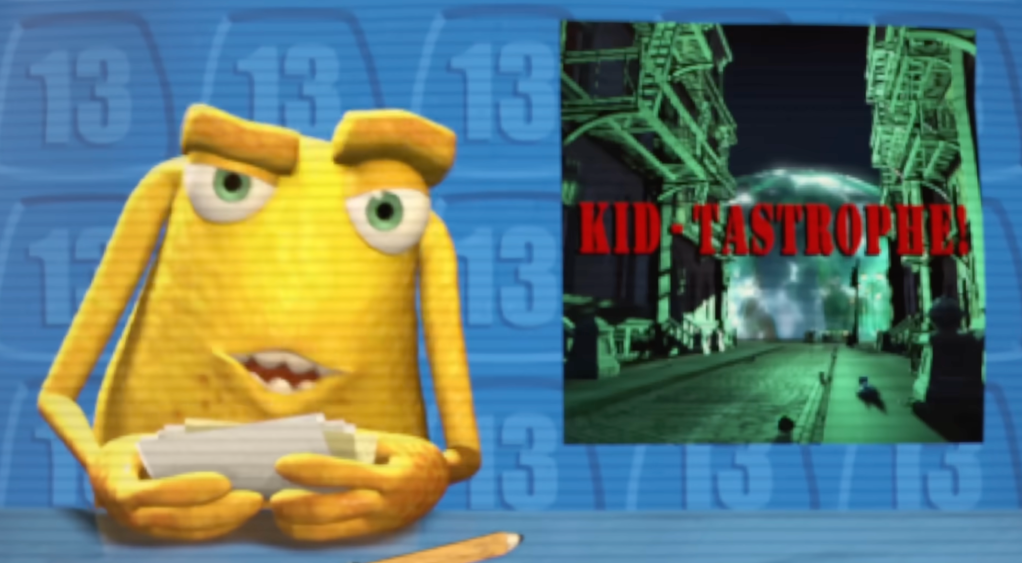
The broadcast then cuts to dramatic footage of CDA agents hurriedly searching for Boo around Harryhausen’s. The location matters. Harryhausen’s is not an anonymous corner of Monstropolis but its fashionable, hard-to-enter sushi restaurant: a place where monsters go not only to eat but to be seen. Boo has therefore penetrated a socially selective space near the heart of public life. Had she appeared somewhere less visible or socially valued, her presence might have been dismissed as rumour, officially denied or ignored by the media altogether. At Harryhausen’s, however, there are too many witnesses—and too much social visibility—for the sighting to remain private. Approached by an on-the-ground reporter, an otherwise anonymous CDA agent, identifiable only as 0002, responds: “We can neither confirm nor deny the presence of a human child here tonight” (ibid., 00:28:42–00:28:46). Although the formula appears institutionally cautious, it neither challenges the premise of the report nor diminishes its urgency; instead, official uncertainty allows the imagined danger to remain in circulation. The broadcast then escalates through selected eyewitness accounts claiming not only that the child presents a danger to life but that children can fly, possess “laser vision” capable of blasting objects and exercise “mind powers” with which they can lift and violently shake monsters (ibid., 00:28:46–00:28:57). These claims are transmitted without challenge or corroboration, introducing into the public imagination a child whose powers no monster could reasonably be expected to resist. Their comic absurdity, however, depends upon viewers knowing what the monsters do not. Human audiences recognise immediately that Boo possesses none of these powers, whereas most monsters understand children only through institutional warnings and culturally circulated mythology. With no ordinary experience of human children against which the eyewitness accounts can be tested, even the most outlandish claims become culturally plausible. The expert’s concluding call for panic consequently acquires its full sociological significance: rather than subjecting the eyewitness claims to professional scrutiny, he ratifies them, converting uncorroborated testimony into an apparently authoritative diagnosis of public danger (ibid., 00:28:57; see Figure 3).
By the following day, The Monstropolis Horn has carried this construction into print. Its front page is crowded with alarming headlines: “Kid Sighting at Sushi Bar”, “Child Feared Loose in City”, “Square Mile Evacuated Around Toxic Site” and “Monster Threat”, alongside Boo’s photograph and the warning that the sighting “raises huge security questions” (ibid., 00:43:26). Even the headline— “Stay Calm Pleads Mayor: Child Detection Agency Investigating” (ibid.)— simultaneously offers political reassurance and confirms official concern. Cohen’s (2002/2011) sequence is clearly visible: unsupported testimony is selected and stylised by television, authenticated by an accredited expert, amplified through the press and ratified by political and regulatory authorities. An excitable toddler with no demonstrable capacity to harm anyone is thereby transformed by the media into a sushi-bar-invading, flying, laser-firing, mind-controlling menace capable of threatening an entire city.
The CDA’s response most directly completes Cohen’s sequence (ibid.). Its agents do not quietly investigate Boo’s appearance; they occupy the ground and airspace surrounding Harryhausen’s. Armoured personnel carriers career through the streets, helicopters equipped with searchlights noisily patrol the sky, and advanced technology seals the area beneath an enormous containment dome. The following day, they swarm M.I. with detection equipment, searching for evidence of child contamination and attempting to identify the source of an unprecedented security breach. Their objective is to track down and contain the diminutive folk devil before returning her to the unlikely place from which she came: her bedroom. This intervention is highly visible, intrusive and frightening. It does not merely search for Boo but publicly confirms that an emergency exists. The authorities make the threat appear commensurate with the scale of their response.
Waternoose’s actions are analytically different. His forced banishment of Sullivan and Wazowski to the Himalayas is not an official response to Boo’s supposed danger but a clandestine use of the same door technology to suppress witnesses and conceal the genuinely dangerous Scream Extractor, thereby protecting his family’s long-standing ownership of M.I. The panic therefore provides useful cover: while public attention and CDA resources are concentrated on finding one harmless child, Waternoose employs the border apparatus to conceal corporate wrongdoing. The machinery ostensibly protecting Monstropolis becomes a means of coercion.
Hazard to Haphazard
The resolution is more complicated still. Led by Roz—Agent 001—the CDA eventually identifies and arrests Waternoose following an extensive undercover operation, distinguishing the genuine danger from the imagined one. Yet the agency does not immediately abandon the foundational belief that children and monsters must remain separated. Boo is returned to her bedroom, and her closet door is shredded, with Roz telling Sulley that he can never see her again because “that’s the way it has to be” (Monsters, Inc., 2001, 01:17:39). The immediate panic subsides and its corporate beneficiary is removed, while the border regime that constructed Boo as dangerous appears to have been restored.
This restoration proves temporary. Roz may have institutionally closed Boo’s door, but she cannot close down what Boo has made visible: human children are neither toxic nor untouched by the fear monsters extract from them. The child constructed as a warning sign of social collapse instead reveals the possibility of social renewal. Monstropolis abandons the increasingly unproductive extraction of fear for an energy economy in which fun produces laughter and laughter generates power. Waternoose’s fear factory, sustained by the belief that children are hazardous, finally gives way to Sulley’s fun factory, populated by monsters who are decidedly more haphazard. The transformation lends unexpectedly literal force to Cohen’s observation that studying moral panics—whether in the human world or the monster one—can be “a lot of fun” (Cohen, 2002/2011, p. xliv).
References
Aitken, S. (2018) ‘Introduction’. In: Aitken, S. ed. Using Film to Understand Childhood and Practice. London: Bloomsbury, pp. 1–8.
Barber, S. (2015) Using Film as Source. Manchester: Manchester University Press.
Booker, M.K. (2010) Disney, Pixar, and the Hidden Messages of Children’s Films. Santa Barbara, CA: ABC-CLIO.
Cohen, S. (2002/2011) Folk Devils and Moral Panics: The Creation of the Mods and Rockers. 3rd edn. Abingdon: Routledge Classics.
Giddens, A. (1991) Modernity and Self-Identity: Self and Society in the Late Modern Age. Cambridge: Polity Press.
Hunter, L. and Frawley, E. (2022) ‘Engaging Students Using an Arts-Based Pedagogy: Teaching and Learning Sociological Theory through Film, Art, and Music’, Teaching Sociology, 51(1), pp. 13–25.
Monsters, Inc. (2001) Directed by Pete Docter. Available from: Disney+ [Accessed 29 July 2026].
Suggested citation: Birkenshaw, C. (2026) ‘Boo! Moral Panic in Monsters, Inc.’ Altered States of Academia, 29 July [Online blog]. Available from:< >[Accessed?].
Acknowledgement: Generative AI (ChatGPT) was used as a writing support tool to assist with editing, improving clarity, and refining the structure of the text. The arguments, analysis, and final decisions regarding content remain the author’s own.
 Altered States of Academia
Leave a comment