Claire Birkenshaw
One of the most memorable plot twists in children’s literature occurs in The Wonderful Wizard of Oz (Baum, 1900) when the collapse of a carefully constructed façade reveals that the seemingly omnipotent Wizard is not the powerful figure he appears to be, but rather a “humbug”—“just a common man” whose authority derives not from the supernatural, but from technological trickery (ibid., p.120). In this sense, Baum’s novel invites readers to reflect on the ways their own lives may be shaped by individuals and institutions that appear all-powerful but are, in reality, “false wizards” (ibid., p.121). As Donovan (1987/2006, p.38) argues, the novel’s exposure of the “irrational” and “incomprehensible” power structures of adult society is made possible because Dorothy is a child. Positioned in opposition to the adult world she encounters, Dorothy occupies the role of an outsider whose perspective enables both her and the reader to question assumptions that others accept without scrutiny. Through Dorothy’s eyes, Baum explores the taken-for-granted political and cultural structures that shape everyday life, both within the imaginary Land of Oz and beyond it.
Dorothy’s journey can therefore be understood as a useful metaphor for the sociological endeavour. Her outsider status enables her to adopt a critical perspective towards the social world she encounters, reflecting the sociological practice of making the familiar appear strange. Despite the numerous obstacles she faces, Dorothy remains committed to achieving her goal of returning home to Kansas, demonstrating a persistence that parallels the sociologist’s pursuit of understanding. Moreover, although Dorothy initially appears small and powerless, she ultimately possesses greater agency than either she or those around her recognise. In this respect, she embodies what Donovan (1987/2006, p.38) describes as “culture’s underdog”, a position that parallels the sociologist’s role in questioning dominant assumptions and revealing hidden structures of power.
For sociologists Woodman and Threadgold, the purpose of sociology is to uncover the “hidden dimensions” that “shape our social worlds” and to “better understand how power works” (2021, p.1, emphasis in original). They argue that a sociological gaze enables individuals to recognise how their choices may appear freely made while remaining shaped by wider systems of power, culture, and social control. This perspective is particularly significant in societies that place considerable value on the idea of individual freedom of choice. To assist students in developing their sociological gaze, Woodman and Threadgold propose four interconnected question themes:
Historical questions explore how contemporary social practices, beliefs, and institutions have developed across time and space, examining their origins and transformations.
Cultural questions investigate how shared values, norms, meanings, and beliefs influence how individuals interpret the world and organise their behaviour.
Structural questions examine how social institutions and broader economic and political systems shape opportunities, experiences, and life chances.
Critical questions challenge existing social arrangements by considering whose interests they serve, revealing underlying power relations, and exploring alternative possibilities for organising society.
Together, these questions encourage students to move beyond individual experiences and examine the broader social forces that influence human behaviour and social life. As such, they can be applied to cultural artefacts, including literature and film, to illuminate sociological concepts and develop students’ understanding of the social world. An illustrative example of the hidden structures of power can be found in the Wizard’s rule over the Ozites in The Wonderful Wizard of Oz.
Before Oscar Diggs—the man who would become the Wizard of Oz—arrived accidentally in the Land of Oz in his circus hot-air balloon, the Emerald City did not exist. His arrival created the conditions for a new social order because the Ozites interpreted his descent “from the clouds” (Baum, 1900, p.123) in an unfamiliar machine as evidence of supernatural power. Diggs quickly recognised that his authority did not originate from any genuine ability, but from the meaning that the Ozites attached to his arrival. While his true identity was merely that of an ordinary carnival balloonist from Omaha (ibid., p.122), he understood that perception itself could become a source of power. By concealing his identity, he preserved the illusion of being a “Great” and “Terrible” figure (ibid., p.84), knowing that the Ozites would “willingly” accept his commands (ibid., p.123).
From a sociological perspective, Diggs’s authority is constructed through legitimacy rather than force. His power depends upon the collective belief that he possesses qualities beyond ordinary human capability. The Emerald City therefore represents more than a physical location; it is a material expression of a social system built upon manufactured belief. By ordering the construction of a magnificent green-walled city, Diggs created a visible symbol of his supposed greatness. The city reflected the natural imagery of Oz while simultaneously reinforcing the perception that its ruler possessed extraordinary status.
Although Diggs later presents the city’s creation to Dorothy as a harmless project intended simply to keep “the good people busy” (ibid., p.123), the city’s architecture functions as a mechanism of social control. The walls provide protection not only from imagined external dangers but also from threats to Diggs’s authority. Externally, he uses the threat of the Wicked Witches to justify fortifications and restrictions on movement. However, this fear also reveals his own insecurity: Diggs understands that if his deception were exposed or challenged by someone with genuine power, he would be “destroyed” (ibid., p.124). The walls therefore protect both citizens from an invented danger and the ruler from the possibility of losing legitimacy.
Internally, the Emerald City transforms Diggs’s personal influence into an organised system of control. Access is regulated through the “Guardian of the Gates” (ibid., p.75), while the compulsory wearing of green-tinted spectacles ensures that citizens experience the city according to Diggs’s carefully constructed vision. Like the city walls, the spectacles are presented as necessary for protection. Diggs claims that the glasses shield Ozites from the overwhelming “brightness” and “glory” (ibid., p.75) of the Emerald City; however, their deeper function is ideological. They ensure that citizens perceive reality in a manner that supports his authority.
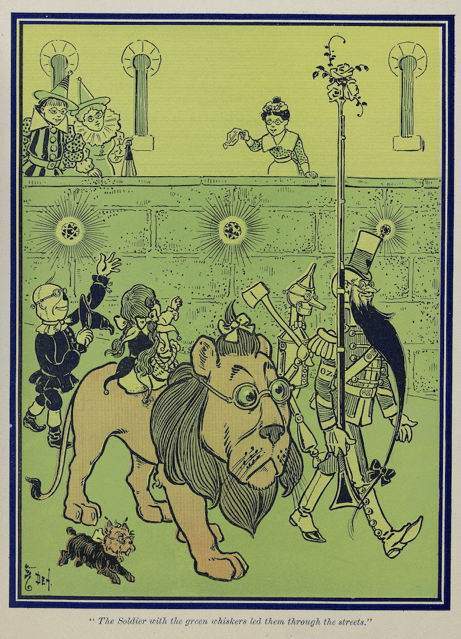
The locking of the spectacles into place (ibid., p.75) demonstrates how social control can operate through the internalisation of rules rather than through physical violence. Once the glasses become compulsory, questioning the city’s appearance becomes increasingly difficult because every citizen literally views the world through Diggs’s imposed perspective. Dorothy’s silence when the glasses are secured onto her illustrates how compliance can be produced through social expectation and institutional authority. The spectacles do not simply alter vision; they shape collective belief.
Through this manipulation of perception, Diggs creates the illusion that the city is genuinely made of emeralds and that its grandeur reflects his supernatural abilities. The name “Emerald City” reinforces this shared belief, transforming an artificial construction into a socially accepted reality. In this sense, Diggs demonstrates how power can be maintained not only through coercion, but through the creation of meanings that people willingly accept.
To summarise Diggs’ mechanism of power over the Ozites:
Constructing legitimacy: His arrival is interpreted as evidence of supernatural power, allowing him to appear deserving of obedience.
Controlling perception: The green-tinted spectacles shape how citizens experience the Emerald City, making an ordinary city appear magnificent and magical.
Creating shared beliefs: By encouraging Ozites to believe that the city is made of emeralds and that he possesses extraordinary abilities, Diggs transforms an illusion into a social reality.
Institutionalising control: The walls, the Guardian of the Gates, and compulsory spectacles embed his authority into everyday practices rather than relying on constant force.
The Emerald City therefore provides a sociological example of manufactured consent. Diggs does not rule primarily through physical force; instead, he reshapes Ozite society by controlling what its inhabitants see, believe, and understand. By appealing to their imaginations and desires, he creates a system in which obedience appears voluntary, even when it has been carefully engineered.
In a classroom context, this example can provide students with a framework for examining how consent to systems of power can be manufactured through the control of knowledge, perception, and meaning, while encouraging them to question whether different forms of social organisation are possible. The sociological gaze therefore acts as a removal of the green-tinted spectacles, allowing students to see beyond taken-for-granted assumptions and recognise the social forces that shape their lives.
References
Baum, L.F. (1900) The Wonderful Wizard of Oz. [Online]. Oxford Text Archive. [Accessed 10 June 2026]. Available from: https://ota.bodleian.ox.ac.uk/repository/xmlui/handle/20.500.12024/3231
Donovan, A. (1987/2006) “Alice and Dorothy: Reflections from Two Worlds.” In: Children’s Literature Review. Vol. 216. Detroit: Gale Cengage. pp.35-39.
Woodman, D. and Threadgold, S. (2021) This is Sociology: A Short Introduction. London: SAGE Publications Ltd.
Suggested citation:
Birkenshaw, C. (2026) Seeing Through the Emerald Lens: The Wizard’s Systems of Power in The Wonderful Wizard of Oz. Altered States of Academia, 12 June [Online blog]. Available from:<https://alteredstatesofacademia.blog/2026/06/12/seeing-through-the-emerald-lens-the-wizards-systems-of-power-in-the-wonderful-wizard-of-oz/> [Accessed?].
Acknowledgement: Generative AI (ChatGPT) was used as a writing support tool to assist with editing, improving clarity, and refining the structure of the text. The arguments, analysis, and final decisions regarding content remain the author’s own.
 Altered States of Academia
Leave a comment