Claire Birkenshaw
“No witchcraft, no enemy action had silenced the rebirth of new life in this stricken world. The people had done it themselves” (Carson, [1962] 2002, p.13).
Writing recently in the Guardian, freelance reporter Harriet Grant (2024, n.p.) advances the notion that a “war on play” has been enacted across the UK in which children’s outdoor play is now perceived as a form of “antisocial behaviour” in need of adult correction and control. Seemingly innocuous adult interventions, intended to shape where and how children play or even deny it altogether, have played their part in “profoundly changing childhood” (ibid.) as we know it.
In this blog, I illustrate how the design features of a designated children’s play area may have unintended consequences on the nature of children’s play as conceived by the Committee on the Rights of the Child (2013).
According to the Committee on the Rights of the Child (2013, p.3) play is defined as “any behaviour, activity or process initiated, controlled and structured by children themselves; it takes place whenever and wherever opportunities arise.” Moreover, they posit that children’s play “involves the exercise of autonomy, physical, mental or emotional activity, and has the potential to take infinite forms, either in groups or alone” (ibid.).
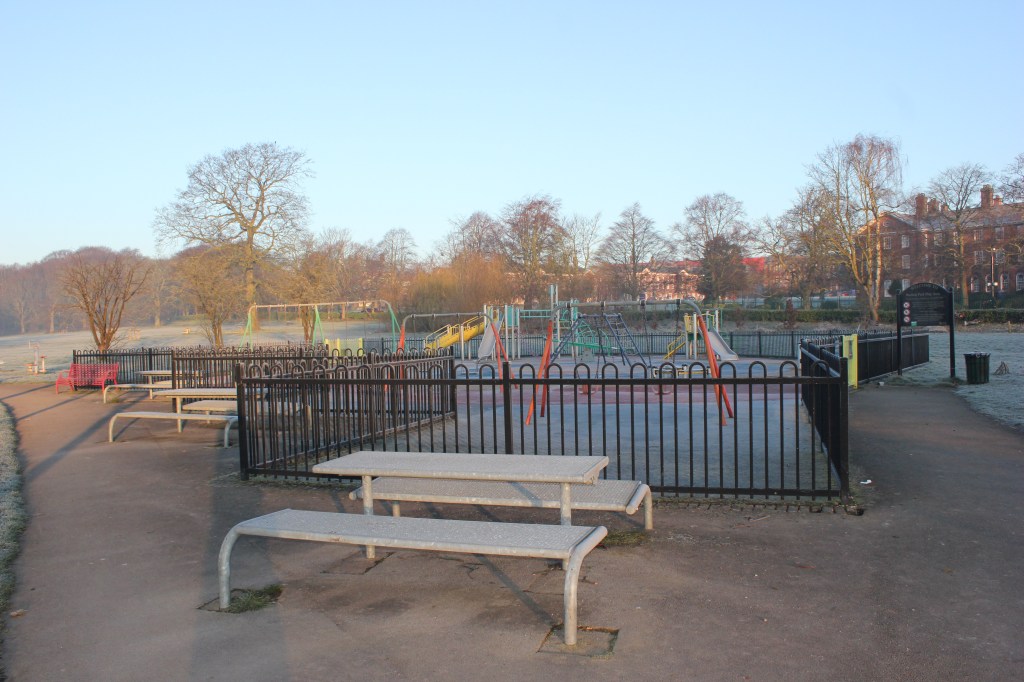
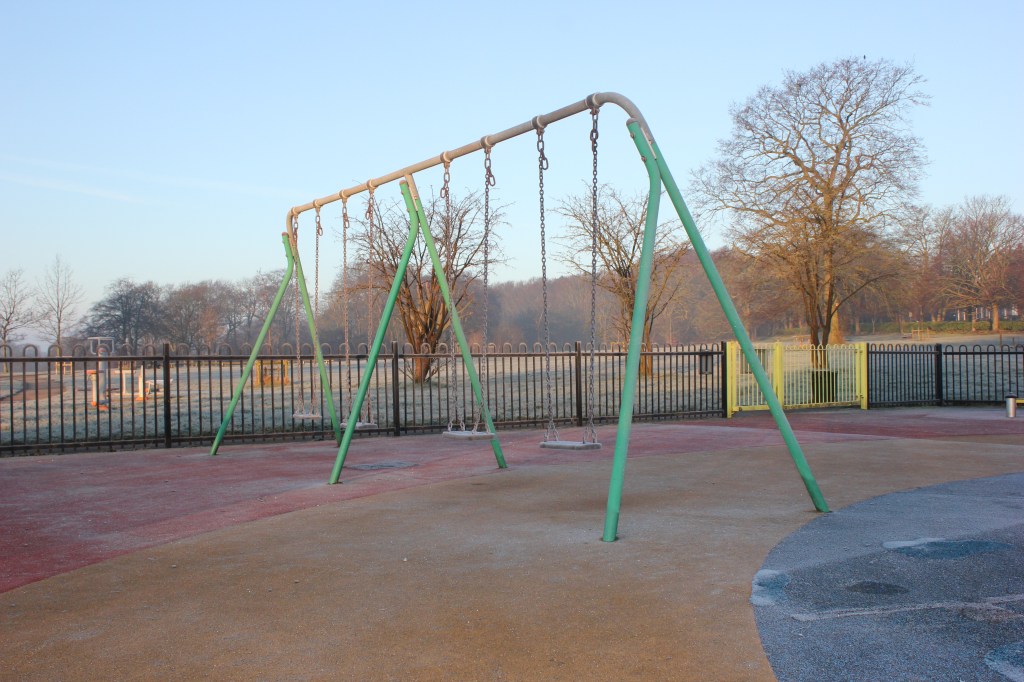
Birkenshaw, C. (2024) Beckett Park: Play area [Photograph]. Leeds. ©Claire Birkenshaw.
Beckett Park play area (Photo A) in the city of Leeds (UK) configures to what we imagine a typical play area for children to look like due to the provision of apparatus: swings, slides and a climbing frame. As such, it appears the child’s right “to engage in play and recreational activities appropriate to [their] age” (United Nations, 1989, Article 31) has been recognised and fulfilled by Leeds City Council, and therefore a positive action in support of children and childhood. However, its design features, arguably, may inhibit children’s play, as imagined by the Committee on the Rights of the Child (2013), because its configuration has been seemingly shaped following the principles of Crime Prevention through Environmental Design (CPTED).
Criminology scholar Rachel Armitage (2017), notes that CPTED projects tend to be underscored by five key principles: defensible space and territoriality; limiting through movement; surveillance; physical security; and management and maintenance.
1. Defensible space and territoriality
The use of the fence, play apparatus, brightly coloured flooring, and signage (Photo B), demarcate and designate this space as a territory for children and supervising adult by creating the sense that it is both separate and different from wider public space. Both children and supervising adult are thus identified as appropriate and legitimate users of this space. Not all children are welcome though. Unaccompanied children and older children (older than fourteen) are classified as non-legitimate users. In effect, the signage helps to establish a “binary division and branding” (Foucault, 1977, p.199) control function to produce a system of classification and recognition to identify both legitimate and non-legitimate users of this play area. As a result, legitimate users are able to claim this space as rightfully theirs, motivating them to both police and regulate this area because they feel empowered to enforce the rules of legitimate play.
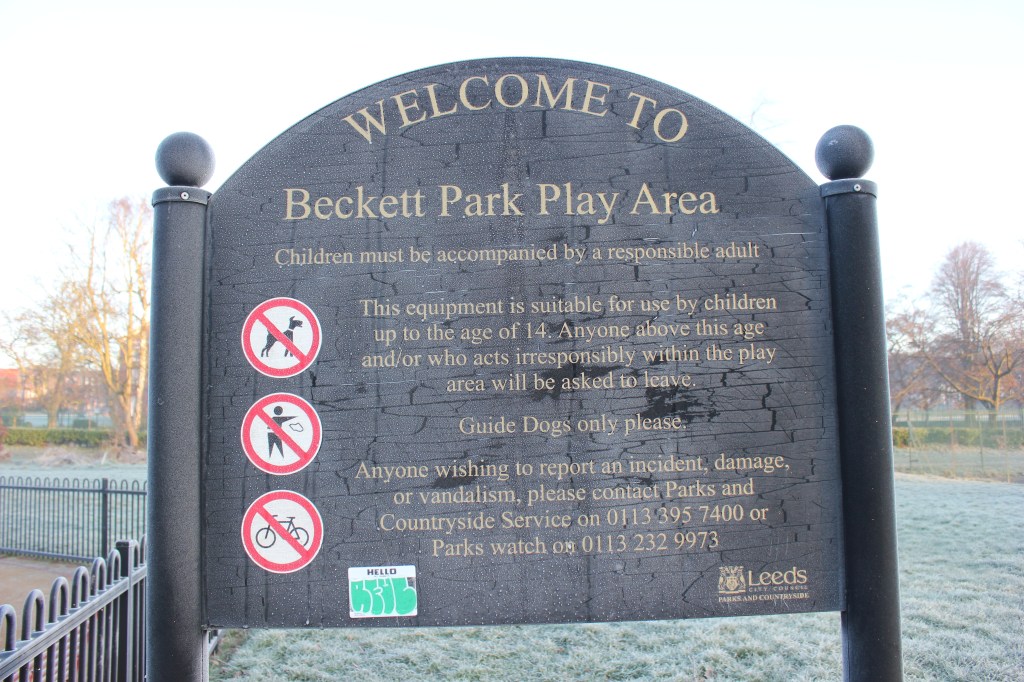
Birkenshaw, C. (2024) Beckett Park: Welcome Sign [Photograph]. Leeds. ©Claire Birkenshaw.
2. Limiting through movement
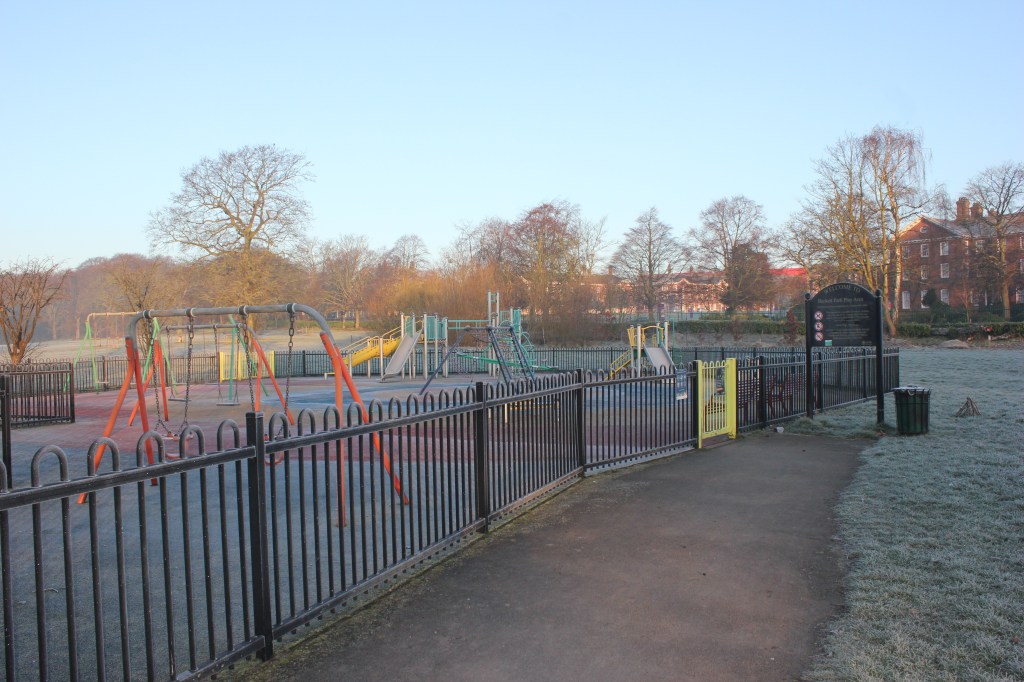
The play area has two identifiable access/egress points (Photo C). These gates control movement in and out of the play area and help to prevent young children leaving without their adult chaperone. However, the gates act also as a form of border control, and reinforce understanding of who is permitted into the space. Opening the gate and entering the play area is a deliberate act of rule transgression if perpetrated by a non-legitimate user, cementing the idea they are not able to follow rules, thus do not belong in the space and must leave for the safety of others.
3. Surveillance
The transparent design of the play space – there are no hidden / hiding spaces (Photo A) – ensure a “field of visibility” (Foucault, [1977] 1991, p.202). Thus, all users of the area are subject to the power of surveillance: any form of inappropriate behaviour can be observed and remedied. The result is that children pre-empt adult intervention and modify their play accordingly to satisfy the demands of appropriate play. Further, the chaperoning adult acts as an informal hierarchical observer of conduct. In effect, children inscribe this power relation and subject their own play to internal interrogation and seek to conform and adhere to the rules of appropriate play. Adults are ensnared also by the power of surveillance, fully aware that their ‘conduct of the conduct’ (parenting) is being observed by others. Hence, the conduct of ‘play’ and ‘parenting’ are trapped in this field of visibility. As Foucault ([1977] 1991, p.203) points out, the compounding effects of ever-present surveillance are “profound and permanent.”
4. Physical security
The metal physical features of this play area are hardened, tough, and durable (Photo A). They secure the physical longevity of the play area because they are hard to damage and vandalise. In effect, these design features seek to design out criminal damage. However, while use of metal may be thought of as being a robust crime prevention material it lacks naturalness and is at odds with the surrounding natural environment. Furthermore, the use of metal may help to reinforce the idea that children are the perpetrators of criminal damage, thus in need of hardened forms of control.
5. Management and maintenance
Again, the use of durable metal helps to maintain the management and maintenance of the area because the play area is difficult to damage. The addition of bins on the perimeter of the play area help to prevent litter and maintain its clean appearance. An undamaged visual aesthetic motivates park users to assist informally in its management and maintenance.
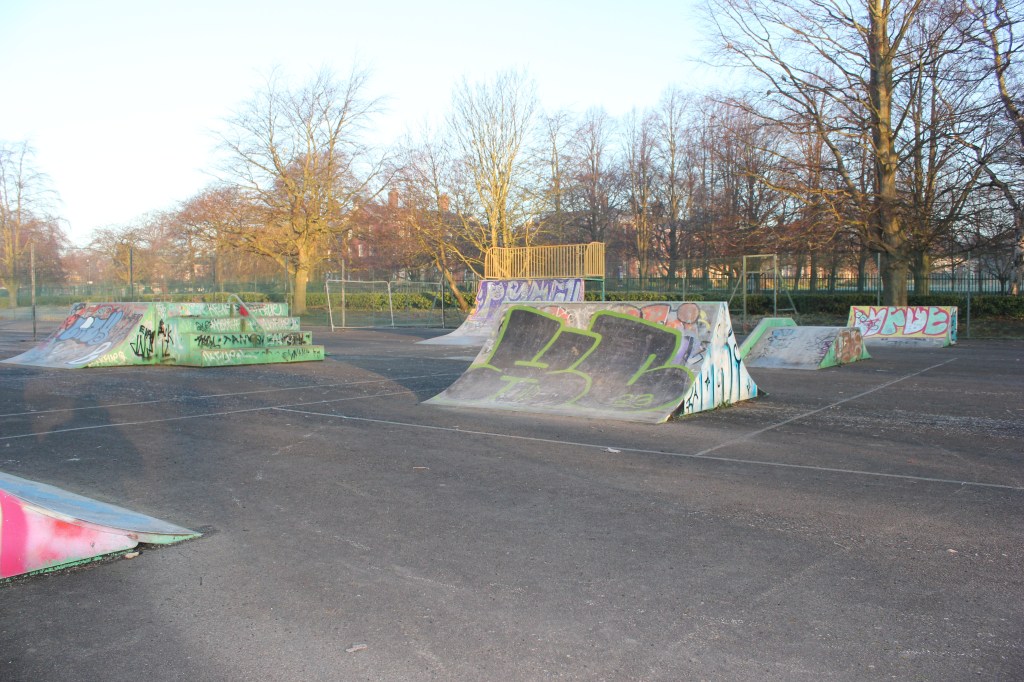
While there is no doubt that provision of a play area is beneficial to both children and the wider community, play area designers should consider whether their park design limits the different dimensions of free play (e.g., physical, object, pretend). For example, Beckett play area transmits that only accompanied children can play legitimately in this designated space. In effect, not only does this restrict the autonomy of play, but it prevents children from gathering and playing away from adult supervision; play designers should bear in mind that not all children have the resource of a freely available responsible adult to chaperone their play. Moreover, adult supervision may hinder children’s risky play – an important component in their development, health and wellbeing (Brussoni et al., 2012). Another factor to consider concerns the play provision for older children, given they too are covered by UNCRC (1989). Beckett play area makes clear it is not designed for children aged fourteen and above. Given that adult accompaniment is a requirement too, it communicates that autonomous children younger than fourteen are not welcome either. This transmits to older children, as Brunelle et al. (2018, p.362) highlight, they are not welcome in “the public realm for a variety of reasons.” As Brunelle et al. (ibid.) point out, older children “are often purposely designed out of public spaces” to satisfy adult concerns about safety, criminality, and morality. To address this, Beckett Park provides a skate park for older children (Photo D). While this may be considered to be an inclusive action by Leeds City Council directed at older children, Brunelle et al. (ibid.) stress that “skate parks serve as a way to control youth behaviour.”
Finally, I hope I have brought to light, albeit briefly, how certain aspects of park design may inadvertently limit or inhibit free play for children, particularly older children, which has resulted in the gradual sterilisation and silencing of the types of play necessary for optimal child development. In her seminal book, Silent Spring ([1962], 2002), Rachel Carson charts how, in a bid to control ‘pests’, the chemical “war against nature”, set in motion a chain reaction of unintended consequences across the entire fauna flora ecosystem. As she powerfully reminds us: “in nature nothing exists alone” (Carson, [1962] 2002, p.30). If indeed a “war on play” has been enacted by adults on children, as Grant posits (2024), and if we continue on this path, it is feasible to imagine, as Carson once did, that the unintended consequence of seemingly unconnected adult actions to address ‘anti-social’ behaviours will lead to the eventuality of a non-social silent childhood swing.
References
Armitage, R. (2017) Crime Prevention through Environmental Design. In: Wortley, R. and Townsley, M. eds. Environmental Criminology and Crime Analysis. 2nd ed. Abingdon: Routledge. pp.259-285.
Brunelle, S., Brussoni, M., Herrington, S., Matsuba, M.K. and Pratt, M.W. (2018) Teens in Public Spaces and Natural Landscapes: Issues of Access and Design. In: Lansford, J.E. ad Banati, P. eds. Handbook of Adolescent Development Research and Its Impact on Global Policy. New York: Oxford University Press. pp.361-379.
Brussoni, M., Olsen, L.L., Pike, I. and Sleet, D.A. (2012) Risky Play and Children’s Safety: Balancing Priorities for Optimal Child Development. Int. J. Environ. Res. Public Health, 9, pp.3134-3148.
Carson, R. ([1962] 2002) Silent Spring. New York: First Mariner Books.
Committee on the Rights of the Child (2013) General comment No. 17 on the right of the child to rest, leisure, play, recreational activities, cultural life and the arts (art. 31). New York: United Nations.
Foucault, M. ([1977] 1991) Discipline and Punish: The Birth of the Prison. Translated from the French by A. Sheridan. London: Penguin.
Grant, H. (2024) Look at streets and open spaces: where are all the children? Blame the war on play. The Guardian [Online]. 26 March. Available from:< https://www.theguardian.com/society/commentisfree/2024/mar/26/remember-playing-out-with-friends-your-children-wont-play> [Accessed 26 March 2024].
United Nations (1989) Convention on the Rights of the Child. New York: United Nations.
Suggested citation
Birkenshaw, C. (2024) Silent Swing. Altered States of Academia, 30 March [Online blog]. Available from:<https://alteredstatesofacademia.blog/2024/03/30/silent-swing/> [Accessed ?].
 Altered States of Academia
Leave a comment