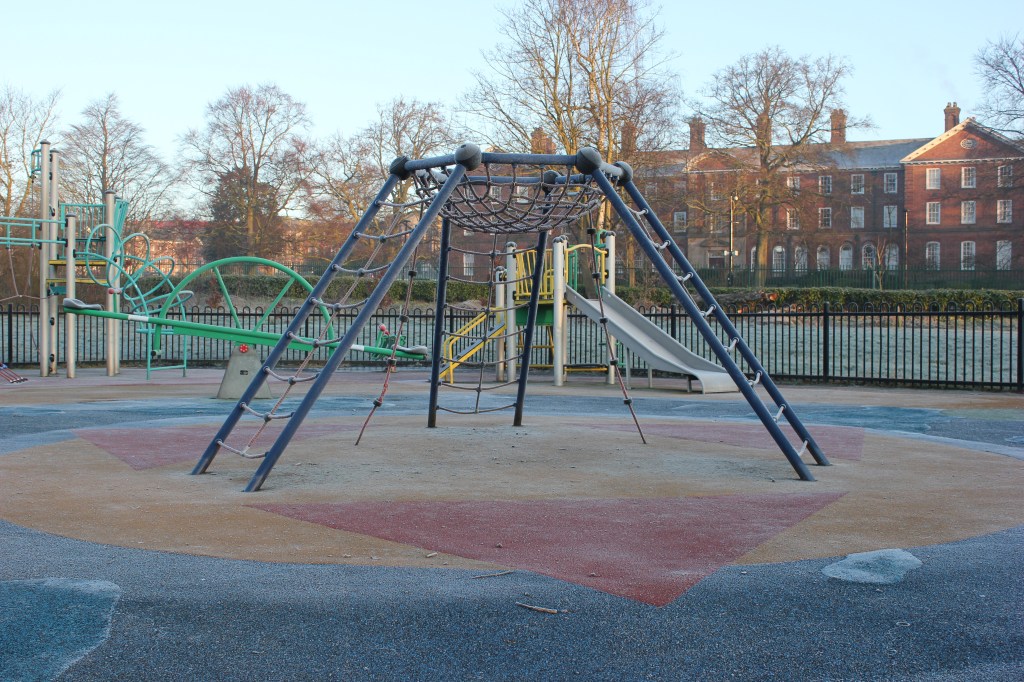
Birkenshaw, C. (2024) Beckett Park: Climbing Frame [Photograph]. Leeds. © Claire Birkenshaw.
Claire Birkenshaw
“We [have built] playgrounds that are so monumentally boring that any self- respecting child will go and play somewhere else” (Gill, 2024, quoted in Levelling Up, Housing and Communities Committee, 2024, p.7).
Like the attending Levelling Up, Housing and Committee MPs, I found the oral evidence contributions to the Children, young people and the built environment inquiry, informative, insightful, and illuminating. However, there was one term used during the inquiry, which captured my attention: ‘secured by design’.
Secured by design (SBD) is “an award scheme, run by the Association of Chief Police Officers, which aims to encourage housing developers to design out crime, with a particular emphasis on domestic burglary, at the planning stage” (Armitage, 2000, p.1). Devised in 1989, SBD was initially conceived by South East police forces to counter the rise in domestic burglaries (Armitage and Monchuk, 2011). Supported at the time by the then British prime minister, Margaret Thatcher (Levelling Up, Housing and Communities Committee, 2024), SBD has since been adopted by numerous polices forces across England and Wales.
At its core, SBD is underpinned by five identifiable principles: physical security; surveillance; access/egress; territoriality; and management and maintenance (Armitage and Monchuk, 2011). These principles are rooted in the wider concept of Crime Prevention through Environmental Design (CPTED) (Armitage, 2017). As Armitage notes, CPTED draws upon “opportunity theories” (ibid., p.259) to consider how the intersection of building design and the natural environment influence and shape “crime risk” (ibid., p.259). Thus, CPTED is considered to be “a practical response or intervention to crime risks hypothesised by [opportunity] theories [with the] aim to prevent or reduce crime, by influencing the design, build and management of the built (and sometimes natural) environment” (ibid., p.260). While SBD has been evaluated to confer “a crime reduction advantage” (Armitage and Monchuk, 2011, p.324) beneficial to community residents, its application is argued to have a knock-on effect on children’s opportunities to play (Levelling Up, Housing and Committee, 2024).
Bornat (2024 quoted in Levelling Up, Housing and Committee, 2024) points out that SBD thinking often results in the use of fencing and gates to visibly ‘make safe’ public space, which, in turn, make it “very difficult for children to play outside” (ibid., p.12). This is because these design features “really go against the natural way that children might move around and play” (ibid., p.7, added emphasis). Furthermore, fears about children’s safety, coupled with the “creep of [the] idea of [children’s] anti-social behaviour” (ibid.), help to necessitate and legitimise the shaping of the built environment so that it either produces appropriate children’s activity in children’s designated spaces, such as an identifiable play area, or it polices children out of communal public spaces. For example, the placing of ‘No Ball Games’ signs in communal areas, famously satirised by satirical street artist, Banksy (2009), communicates to children that not only is their play activity banned (Lynch, 2024), but they are not welcome.
This approach to ‘design out crime’ through use of SBD methodologies, has prompted me to consider whether something similar has also happened in education. Instead of ‘design out crime’, schools have sought to ‘design out failure’ using principles similar to those that underpin SBD, such as surveillance, in an attempt to address the ‘crime’ of stealing children’s imagined productive adult futures due to exam failure. Unfortunately, like children’s playgrounds, designing out risk because of the ‘fear of failure’, and the stigmatisation of a poor Oftsed report, may have inadvertently resulted in a school experience “so monumentally boring that any self-respecting child [would rather be] somewhere else” (Gill, 2024, quoted in Levelling Up, Housing and Communities Committee, 2024, p.7). Perhaps this helps to explain the recent revelation that there has been a 25% increase in the number of children ‘missing in education’ in England (Children’s Commissioner, 2024): a shocking statistic that the Children’s Commissioner is rightly concerned about and recognises the need to urgently address.
Finally, it is worth thinking as to whether the principles of ‘secured by design’ have shaped other aspects of children’s lives too, such as identity formation. If so, the end result may have led to the construction of a contemporary form of childhood which has been ‘secured by design’.
References
Armitage, R. (2000) An Evaluation of Secured by Design Housing within West Yorkshire – Briefing Note 7/00. London: Home Office.
Armitage, R. (2017) Crime Prevention through Environmental Design. In: Wortley, R. and Townsley, M. eds. Environmental Criminology and Crime Analysis. 2nd ed. Abingdon: Routledge. pp.259-285.
Armitage, R. and Monchuk, L. (2011) Sustaining the crime reduction impact of designing out crime: Re-evaluating the Secured by Design scheme 10 years on. Security Journal, 24 (4), pp.320-343.
Banksy (2009) No Ball Games [spray paint, stencil, aerosol, paint]. London.
Birkenshaw, C. (2024) Beckett Park: Climbing Frame [Photograph]. Leeds.
Children’s Commissioner (2024) New statistics show a huge increase in the number of children completely missing education. Children’s Commissioner, 29 February [Online blog]. Available from:< https://www.childrenscommissioner.gov.uk/blog/shocking-new-statistics-show-a-huge-increase-in-the-number-of-children-completely-missing-education/> [Accessed 9 March 2024].
Levelling Up, Housing and Communities Committee (2024) Oral Evidence: Children, young people and the built environment, HC 94. 26 February. London: House of Commons.
Lynch, S. (2024) Burning ‘no ball game signs’ won’t fix the obesity epidemic – there are way bigger obstacles. The Conversation [Online]. 29 February. Available from:<https://theconversation.com/burning-no-ball-game-signs-wont-fix-the-obesity-epidemic-there-are-way-bigger-obstacles-224301> [Accessed 1 March 2024].
Suggested citation
Birkenshaw, C. (2024) Contemporary Childhood: Secured by Design. Altered States of Academia, 9 March [Online blog]. Available from:<https://alteredstatesofacademia.blog/2024/03/09/contemporary-childhood-secured-by-design/> [Accessed ? ].
 Altered States of Academia
Leave a comment